BASIC STRATEGY
The most important strategy that must be adopted in writing the GS paper 2 or for that matter, any GS paper is that, ‘you must try to finish the paper and write all the questions if possible’. I know it is very tough to do it. But if you do it, the chances of clearing the exam rises exponentially!
SPECIFIC INSRUCTIONS ON THE QUESTION PAPER
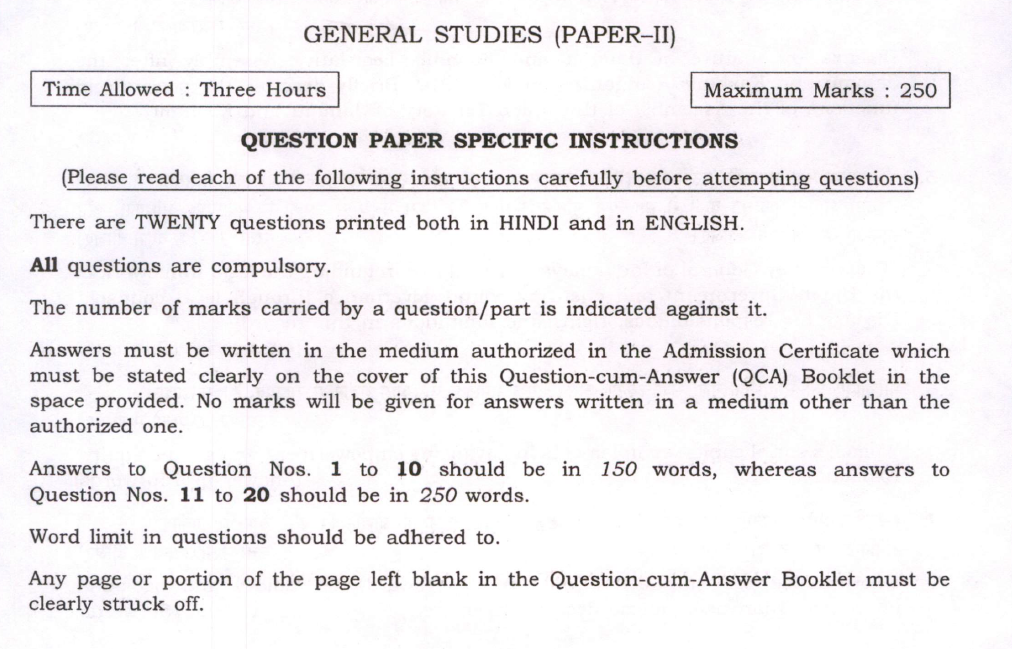
WORD LIMIT AND TIME LIMIT
The paper consists of 10 mark questions and 15 mark questions. The word limit is analysed below.
| MARKS |
WORD LIMIT given by UPSC |
WORD LIMIT for better results |
PAGES GIVEN |
| 10 |
150 |
140-160 (never go below 120) |
2 |
| 15 |
250 |
225-250 (never go below 200) |
3 |
In General studies, it is generally allowed if you write slightly lesser than the allowed maximum word limit. For example, if your answer is very good and you have written only 130 words for a 10 mark question, most examiners give good marks. But you should not write very less words as it will definitely affect your marks obtained.
STRATEGIC TIME MANAGEMENT
| ACTIVITY |
TIME LIMIT for better results |
| INITIAL READING OF QUESTION PAPER |
10 Minutes |
| ANSWERING A 10-MARK QUESTION |
6 to 7 Minutes |
| ANSWERING A 15-MARK QUESTION |
9 to 10 Minutes |
| CONCLUDING REVIEW and PROPER FORMATTING |
5 Minutes |
- The Foundation: Start with a dedicated 10-minute initial reading of the paper to categorize questions by difficulty and plan your sequence of attack.
- Execution Phase: * Allocate 6 to 7 minutes for each 10-mark question, focusing on concise, high-impact points to stay within the 2-page limit.
- Dedicate 9 to 10 minutes for 15-mark questions, allowing more depth for the 3 pages provided.
- The Buffer: Reserved in the final 5 minutes is a crucial period for concluding review and proper formatting, such as underlining keywords or ensuring all unused spaces are struck off.
By following this breakdown, you ensure that you don't over-invest in a single answer at the cost of leaving others blank—a common pitfall in the Mains exam.
STRATEGIZING EACH GS 2 QUESTION
Before writing, spend 30 to 40 seconds on the rough page to map out the legal and institutional framework of your answer. Unlike PSIR, where you focus on thinkers, in GS 2, you must focus on Articles, Cases, and Committees.
Let’s see how to make a rough work map within 30 seconds with an example question below:
Example Question: "Discuss the role of the Finance Commission in strengthening Fiscal Federalism in India."
The Rough Work Map
- Introduction: Article 280; definition of Finance Commission (FC) as a balancing wheel of fiscal federalism.
- Body (Vertical & Horizontal Devolution):
- Data/Stats: 15th FC recommendations (e.g., 41% share to states).
- Criteria: Population, Area, Forest Cover, Demographic performance.
- Constitutional Role: Distribution of net proceeds of taxes between Union and States.
- Critical Points: Cess/Surcharge issues, conditional grants, and performance-based incentives.
- Conclusion: Final judgment on cooperative federalism and the need for a stable fiscal roadmap.
Why Planning is Vital for GS 2
- Eliminates Clutter: Planning ensures you don't forget a crucial Supreme Court Case (e.g., S.R. Bommai) or a Committee (e.g., Punchhi Commission) while writing.
- Logical Flow: GS 2 answers often require a "Multidimensional" approach (Social, Political, Economic). Mapping ensures you touch all three.
- Positive Impression: If you run out of time on a question, a structured rough outline at the end of the booklet might show the examiner you had the right points, potentially saving you half a mark.
BASIC STRUCTURE OF A GS 2 ANSWER
A high-scoring GS Paper 2 answer follows a disciplined, three-part architecture that prioritizes clarity and speed.
Introduction:
The introduction is a small paragraph which MUST introduce the ‘central point of investigation’ either through defining the technical term involved in it or through a relevant quote of a famous thinker of that area. Generally, a quote must be followed by few lines (even a definition) for an effective introduction.
The central point of investigation in a question refers to the main issue, concept, or topic that the question is asking you to focus on and explore. To identify it, ask yourself:
- What is the question primarily asking about?
- What specific aspect or issue am I being asked to address?
- Which command word is used?
Unlike the thematic depth of PSIR, your GS 2 intro should be "fact-heavy" and direct.
Body:
This is the core where you answer the central point of investigation of the question based on the specific "command words" of the question. While PSIR often demands long, scholarly paragraphs, GS 2 favours bulleted points and sub-headings to enhance readability. The body of the answer must consist of the actual answer to the question. It must be based on the question word or command word of the question. Every question will consist of a question word or a command word or both. A question word (or interrogative) used to ask for specific information. Examples are “what,” “how”, “why”, “when” etc. Command words" or "instructional verbs” provide instructions on how to approach a question. Examples are “comment,” “discuss," "examine," or "analyse" etc.
Incorporating flowcharts, maps, or diagrams representing the ‘central point of investigation of the question’ is a proven strategy used by toppers to save time while earning extra marks.
Conclusion:
Writing a good conclusion for a question involves summarising your key points and reinforcing your main argument or findings. You can use the below suggestions to write an effective conclusion:
- Restate the Main Argument: Briefly rephrase the main idea or argument of your response to remind the reader of your focus.
- Summarize Key Points: Highlight the essential points or findings you have discussed, tying them together to reinforce your overall message.
- Provide Insight: Offer a broader perspective or insight related to the topic, such as implications, significance, or future considerations.
- Avoid New Information: Do not introduce new ideas or evidence in the conclusion; focus on wrapping up your existing points.
- Keep it Concise: Aim for clarity and brevity, ensuring that your conclusion is focused and to the point.
To better understand the various 'command words' (such as Discuss, Evaluate, or Critically Analyze) used in GS Paper 2 and to master the techniques for tackling them, please refer to the comprehensive Answer Writing Strategy in the PSIR section. While GS 2 allows for more bulleted points and diagrams compared to the paragraph-heavy style of PSIR, the fundamental logic of addressing these directives remains a crucial overlap between the two.
FINAL TECHNICAL TIPS FOR PEAK PERFORMANCE
To wrap up your answer writing strategy for GS Paper 2, keep these final technical and aesthetic points in mind to ensure your hard work is presented effectively:
- Pen Selection: Use a high-quality ballpoint or gel pen (typically blue or black) that you have practiced with extensively. Ensure it doesn't smudge and offers a comfortable grip for three hours of continuous writing.
- Handwriting & Legibility: While you don't need "artistic" calligraphy, your writing must be clear and legible. If your handwriting is messy, increase the spacing between lines and words to help the examiner read your points without effort.
- Strategic Underlining: Use a different colour pen or a pencil to underline key keywords, Article numbers, Supreme Court cases, and Committee names. This allows the examiner to see your core arguments at a glance.
- Judicious Use of Space: Since you have a fixed number of pages (2 for 10-markers, 3 for 15-markers), avoid leaving large gaps. If you finish early, use flowcharts or hubs-and-spoke diagrams to fill the white space and add visual value.
- The "Strike-Off" Rule: If you leave any page or significant portion of a page blank, remember to draw a diagonal line across it as per UPSC instructions to indicate the end of your response.
- Avoid Over-Decoration: Focus on content over aesthetics. One simple box around a conclusion or a clean flowchart is better than using multiple colored pens or highlighters, which can waste precious minutes.