The most important strategy for General Studies Paper 4 (Ethics) is to demonstrate that you possess the values expected from a future civil servant. Unlike other GS papers, this paper does not merely test your knowledge of concepts. Instead, it evaluates whether you can apply ethical reasoning to real governance situations.
Therefore, your answers should not look like memorised textbook definitions. The examiner must feel that you understand the spirit of ethics in governance. This is particularly important in the case studies section, where the focus is on your ability to take balanced, rational, and morally defensible decisions.
Another important strategy is similar to other GS papers: try to attempt all questions. Leaving questions unanswered significantly reduces your chances of scoring well. Even if you are unsure about a question, write a logical and value-based answer rather than leaving it blank.
The paper consists of 10 mark questions and 15 mark questions. The word limit is analysed below.
| MARKS | WORD LIMIT given by UPSC | WORD LIMIT for better results | PAGES GIVEN |
|---|---|---|---|
| 10 | 150 | 130-150 (never go below 120) | 2 |
| 20 (Case Study) | 250 | 230-260 (never go below 200) | 3 |
For Section A questions, it is acceptable to write slightly below the maximum word limit if your points are clear and meaningful. However, writing too short answers will reduce your marks, especially when the question expects explanations or examples.
For case studies, try to utilise the space effectively because these questions evaluate analytical thinking and ethical reasoning.
| ACTIVITY | TIME LIMIT for better results |
|---|---|
| INITIAL READING OF QUESTION PAPER | 10 Minutes |
| ANSWERING A 10-MARK QUESTION | 6 to 7 Minutes |
| ANSWERING A CASE STUDY | 12 to 15 Minutes |
| FINAL REVIEW AND FORMATTING | 5 Minutes |
The Foundation:
Spend the first 10
minutes reading the entire question paper carefully.
Identify questions that appear easy and attempt them
first.
Execution Phase:
Allocate around 6–7
minutes for each Section A question. Since these are short
conceptual questions, your answers should be precise and
structured.
For case studies, spend around 12–15 minutes.
These require deeper thinking because you must analyse the
situation and propose ethically sound solutions.
The Buffer:
Reserve the
final 5 minutes for reviewing the answer booklet. Underline
important ethical terms such as integrity, accountability,
transparency, empathy, and public interest wherever
appropriate.
Before writing a Section A answer, spend 20–30 seconds on the rough page to plan the answer. Unlike GS-2 where you focus on Articles, Cases, and Committees, in GS-4 you must focus on ethical concepts, thinkers, examples, and administrative values.
Let’s see how to make a rough work map within 30 seconds with an example question below:
Example
Question:
"What do you understand by the term ‘probity in governance’? Why is it important in public administration?"
Rough Work Map
A high-scoring GS Paper 4 (section A) answer follows a disciplined, three-part architecture that prioritizes clarity and speed.
The introduction is a small paragraph which MUST introduce the ‘central point of investigation’ either through defining the technical term involved in it or through a relevant quote of a famous thinker of that area. Generally, a quote must be followed by few lines (even a definition) for an effective introduction.
The central point of investigation in a question refers to the main issue, concept, or topic that the question is asking you to focus on and explore. To identify it, ask yourself:
This is the core where you answer the central point of investigation of the question based on the specific "command words" of the question. While PSIR often demands long, scholarly paragraphs, GS 4 (section a) favours bulleted points and sub-headings to enhance readability. The body of the answer must consist of the actual answer to the question. It must be based on the question word or command word of the question. Every question will consist of a question word or a command word or both. A question word (or interrogative) used to ask for specific information. Examples are “what,” “how”, “why”, “when” etc. Command words" or "instructional verbs” provide instructions on how to approach a question. Examples are “comment,” “discuss," "examine," or "analyse" etc.
Incorporating flowcharts, maps, or diagrams representing the ‘central point of investigation of the question’ is a proven strategy used by toppers to save time while earning extra marks.
Writing a good conclusion for a question involves summarising your key points and reinforcing your main argument or findings. You can use the below suggestions to write an effective conclusion:
To better understand the various 'command words' (such as Discuss, Evaluate, or Critically Analyze) used in GS Paper 4 (SECTION A) and to master the techniques for tackling them, please refer to the comprehensive Answer Writing Strategy in the PSIR section. While General studies papers allows for more bulleted points and diagrams compared to the paragraph-heavy style of PSIR, the fundamental logic of addressing these directives remains a crucial overlap between the two.
Case studies test your ethical reasoning and decision-making ability. A structured approach will help you present clear and convincing solutions.
First identify all individuals or groups affected by the situation. These may include citizens, government institutions, colleagues, political leaders, or vulnerable groups.
Clearly recognise the ethical conflicts involved. Many case studies involve tensions such as:
Recognising these dilemmas is the first step toward ethical reasoning.
Think of two or three possible actions you could take as an administrator. Each option should be lawful and ethically justifiable.
Briefly analyse the advantages and disadvantages of each option. This demonstrates balanced thinking.
Finally, explain the option you would choose and justify it based on ethical values such as integrity, transparency, compassion, accountability, and public interest.
The aim is not to produce an idealistic answer but a practical and ethically sound administrative response.
To ensure your answers are presented effectively, keep the following technical points in mind:
Pen SelectionUse a pen that you are comfortable writing with for three hours. Avoid experimenting with new pens during the exam.
Clarity of HandwritingYour handwriting must be clearly readable. Ethics answers are often evaluated quickly, so legibility helps the examiner understand your points easily.
Strategic UnderliningUnderline important ethical terms such as integrity, empathy, accountability, transparency, objectivity, and public interest. This helps the examiner quickly identify the core arguments of your answer.
Use of Simple Diagrams (when needed)Occasionally you may use simple flowcharts or stakeholder diagrams in case studies to explain ethical relationships. However, avoid unnecessary decoration.
Effective Use of SpaceDo not leave large blank spaces. Use the available pages efficiently while maintaining clarity.
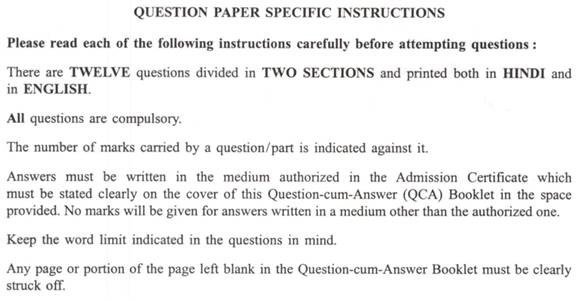
Strike-Off RuleIf any page remains unused, draw a diagonal line across it as instructed by UPSC.