The 2025 PSIR Paper 1 maintains the overarching trend of blending classical political theory with contemporary Indian political issues, though it shifts toward a more analytical and interpretive edge compared to previous years.
1. Section A: Political Theory and Thought
While Section A remains rooted in core concepts, there is an increasing demand for applied understanding and comparative analysis.
- Static but Analytical: Traditional themes like the Marxist and Liberal views of the State (Q2a) and Rawlsian distributive justice (Q2c) appeared as expected. However, questions now require students to interlink these with broader debates, such as Rawls’ use of both liberal and egalitarian perspectives.
- Comparative Approach: The paper emphasizes comparative analysis more than before, seen in the comparison of Behavioural vs. Institutional approaches (Q3a).
- Key Thinkers: Figures such as Karl Popper (Open Society), Hannah Arendt (Vita Activa), and Mahatma Gandhi remain central but are framed through their critique of modernity or individuality.
- Shift in Ideologies: There is a notable focus on contemporary ideological shifts, such as the relationship between equality and liberty from a multicultural perspective (Q1b).
2. Section B: Indian Government and Politics (IGP)
The 2025 paper maintains a balance between the "text" of the Constitution and the "context" of Indian society, though the weightage has clearly shifted toward contemporary political debates.
The segment consists of Indian nationalism, Indian polity and Indian politics (see our decoding syllabus section for more clarity). This year the distribution of questions are as follows
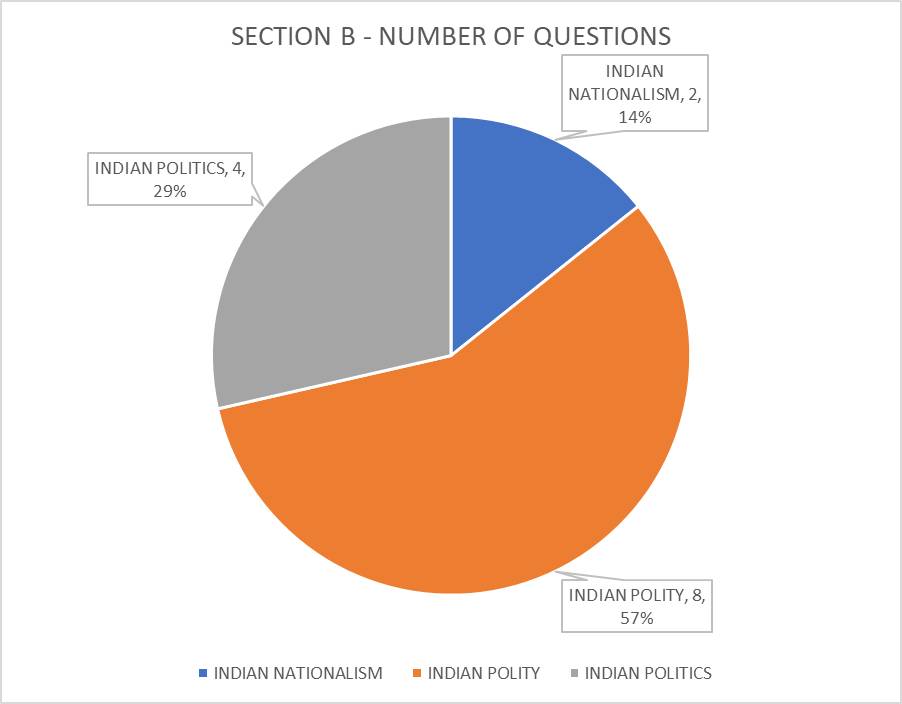
Indian Nationalism (Questions 5a, 5b)
This sub-section continues the trend of moving beyond a monolithic view of the freedom struggle by focusing on marginalized and grassroots narratives.
- Subaltern Voices: The question on the Dalit perspective of the Indian National Movement (5a) reflects the established trend of exploring alternative historiographies.
- Grassroots Protest: The focus on Peasant Movements (5b) highlights the contribution of non-elite groups, emphasizing that the national movement was a result of diverse social mobilizations.
Indian Polity (Questions 5c, 5d, 5e, 6a, 6b, 7a, 7c, 8b)
The "Polity" questions focus on the structural and functional aspects of the Indian state, reflecting a trend toward analyzing institutional efficiency and historical legacies.
- Constitutional Institutions: The 2025 paper addresses live institutional debates, such as the appointment procedure for the Chief Election Commissioner (7c) and the advisory jurisdiction of the Supreme Court (6b).
- Structural Foundations: There is a notable focus on the origins of the modern state, specifically how the Nehruvian perspective (8b) laid the foundation for planning and growth.
- Core Principles: Questions on the Basic Structure doctrine (5c) and the Comptroller and Auditor General (CAG) (5e) reflect the trend of revisiting the "safety valves" of the Indian Constitution.
- Federalism: The question on the "True spirit of federalism" (6a) suggests that the examiner is looking for an analysis of federalism beyond just the division of powers, focusing instead on its lived reality.
| Theme |
2025 Focus |
Relationship to Existing Trend |
| Indian Nationalism |
Dalit and Peasant perspectives. |
Deepening the "history from below" approach. |
| Indian Polity |
Parliamentary Committees and Delimitation. |
Moving from static descriptions to functional and controversial debates. |
| Indian Politics |
Caste Census and Mainstreaming of marginalized groups. |
Direct engagement with the most current socio-political slogans and policies. |
Indian Politics (Questions 6c, 7b, 8a, 8c)
This sub-section represents the most "current" and analytical part of the paper, focusing on how power is negotiated and contested in modern India.
- Political Mobilization: The identification of caste as a "vital axis" for mobilization, linked directly to the Caste Census (7b), follows the trend of testing the intersection of social identity and state policy.
- Legislative Dynamics: The question on Parliamentary Committees (6c) as indispensable to the legislative process highlights a trend of focusing on the "back-end" of democracy and inter-house cooperation.
- Electoral Representation: The reopening of the delimitation debate (8a) following the Census-2027 decision is a prime example of a trend where high-stakes contemporary political events are used to test core concepts of representation.
- Inclusion and Power: Analyzing the role of political parties in mainstreaming disadvantaged groups (8c) reflects the trend of viewing parties as social actors responsible for deepening democracy.
3. Comparison with Previous Trends
| Feature |
Traditional Trend (Pre-2024/25) |
2025 Trend |
| Question Style |
More direct and factual questions in Section A. |
Sharp analytical edge; few direct factual questions. |
| Section B Focus |
Standard constitutional features and roles. |
Live constitutional debates (e.g., ECI appointments, Delimitation). |
| Thinker Usage |
Quoting thinkers for their core ideas. |
Using thinkers to analyze modern phenomena (e.g., Arendt on modernity). |
| Current Affairs |
Current affairs as supplementary examples. |
Current affairs as the primary basis of Section B questions. |
| Difficulty |
Generally Moderate. |
Moderate to Tough due to interpretive nature. |
CONLUSIVE REMARKS FOR PAPER 1
The 2025 PSIR Paper 1 confirms a decisive shift in the UPSC's evaluation criteria: rote learning is no longer sufficient. To succeed in this changing landscape, you must pivot from simply knowing theoretical definitions to mastering the application of those frameworks in the real world.
As consistently highlighted by the trends on the PSIR Online platform, your success depends on three key pillars:
- Conceptual Clarity: You must treat theory as a live, evolving dialogue. Whether you are analyzing Kautilya’s statecraft or the nuances of the "personal is political," your ability to articulate the theoretical core while critiquing its modern relevance is what distinguishes a top-tier answer.
- Current Affairs Integration: As seen in the Section B focus on the Caste Census, Delimitation, and ECI appointment debates, current affairs are the primary lens through which the examiner tests your understanding. Do not view these as separate from your static syllabus; they are the field in which your theoretical knowledge is tested.
- Structural Synthesis: By segregating your prep into Indian Nationalism, Polity, and Politics, you can better categorize how specific historical foundations (Nationalism) inform current institutional debates (Polity) and ongoing power negotiations (Politics).
In short, treat your syllabus as a toolbox. Conceptual clarity is your set of tools, and current affairs are the real-world construction projects you need to fix. Bridging that gap effectively is exactly where those high marks are found.
The 2025 PSIR Paper 2 continues the trend of shifting from static, textbook-heavy questions to highly analytical, "live" geopolitical debates. The paper demands that students treat International Relations not just as a set of theories, but as a framework to interpret shifting global power dynamics.
Section A: Comparative Politics and International Relations
This section has evolved into a test of interdisciplinary thinking, where classical approaches are used to explain modern paradoxes.
COMPARATIVE POLITICS (QUESTIONS 1A, 1D, 2A, 3A, 3C)
The trend here is moving away from simple descriptions of political systems toward behavioral and sociological analysis.
- Methodological Depth: Question 1a on the Psychological Approach to Comparative Politics marks a shift toward testing less traditional methodologies that have recently gained academic traction.
- Societal Dynamics: Question 1d on Political Socialization in open vs. closed societies and Question 2a on the paradox of "democratic backsliding" vs. "democratic backlash" show that the exam is now focusing on the health of global democracy rather than just its structures.
- Global Ideological Shifts: Question 3a addresses the worldwide ascendency of centre-right parties over centrist/centre-left ones. This requires students to link domestic political trends with global socio-economic shifts, a hallmark of the recent UPSC trend.
- Globalization for the South: Question 3c on a "Global South-sensitive model of globalization" reinforces the trend of looking at global processes through the lens of developing nations, moving away from Eurocentric perspectives.
INTERNATIONAL RELATIONS (QUESTIONS 1B, 1C, 1E, 2B, 2C, 3B, 4A, 4B, 4C)
International Relations in 2025 is dominated by non-state actors, security shifts, and institutional crises.
- Theoretical Nuance: Question 1b (Neo-liberalism vs. Neo-realism) is a classic theoretical debate, but 1c (Non-traditional security: food/environment) and 1e (Red Lipstick Movement) show a trend toward broadening the definition of "International Relations" to include gender and human security.
- Institutional Reform: The question on the U.S. withdrawal from the WHO (2b) and the comparison between Collective Security and R2P (3b) highlight the ongoing crisis and necessary reimagining of global governance.
- Regionalism 2.0: Questions on Latin American regionalism (4a), ASEAN Plus Three (4b), and the impact of a Trump return on the EU (4c) show that regional dynamics are being tested as a counter-weight to over-centralized globalization.
Section B: India and the World
This section remains the most dynamic part of the syllabus, where the "Current Affairs Plus" approach is mandatory.
- Evolution of Diplomacy: Question 6a asks for a critical analysis of India's foreign policy phases, specifically evaluating S. Jaishankar’s "Active Diplomacy" phase. This reflects the trend of using contemporary diplomatic terminology as the basis for long-form analysis.
- Strategic Autonomy and Realpolitik: The paper tests India's "balancing act" through questions on Free and Open Indo-Pacific (6b) and the tariff threats pushing India and the EU closer (6c). It moves beyond "friendship" to "interest-based" diplomacy.
- Nuclear Shifts: Question 7a analyzes the shift from the multilateral path to the nuclear Rubicon of 1998, requiring a deep understanding of India's threat perception.
- The "China Factor": India's interests in Africa (7b) and potential trilateral engagement with China and Nepal (7c) follow the trend of analyzing India’s foreign policy as a direct response to China's growing footprint.
CONLUSIVE REMARKS FOR PAPER 2
The 2025 PSIR Paper 2 highlights a defining shift in the examination: the transition from "International Relations as a subject" to "Geopolitics as a practice." The paper demonstrates that success now depends on the ability to perceive global events through an analytical lens rather than just chronicling them.
As reflected in the 2024–2025 trend analysis on the PSIR Online website, your preparation must prioritize the following:
- Deep Conceptual Clarity in Comparative Politics: Section A is no longer about rote-learning definitions. Questions like the Psychological Approach or the paradox of Democratic Backsliding vs. Backlash require a sophisticated understanding of political sociology. You must be able to use these theoretical tools to explain why global patterns are shifting.
- The "Current Affairs Plus" Approach: Paper 2 is almost entirely dynamic. Whether it is the Red Lipstick Movement or the U.S. withdrawal from the WHO, the examiner is looking for your ability to link these headlines to core concepts like "Non-Traditional Security" and "Global Governance." Regular updates from the PSIR Online current affairs section are essential to build this bridge between news and theory.
- Strategic Realism in Section B: India’s foreign policy is being tested through the lens of active diplomacy and strategic autonomy. Moving forward, students should focus on India’s role as a "leading power" rather than just a "balancing power," specifically analyzing its responses to a multipolar world and a rising China.
FINAL CONCLUSION FOR PAPER 1 & 2
The 2025 PSIR papers act as a bridge between deep academic theory and real-time global developments.
- Conceptual Clarity is Non-Negotiable: You cannot "fluff" your way through questions like the Psychological Approach or Democratic Backsliding. You need the precise terminology and the ability to cite relevant scholars (e.g., analyzing Trump’s impact through a Realist lens).
- Focus on PSIR Online Current Affairs: The examiner is clearly reading the same editorials as you. Themes like the Caste Census in Paper 1 and Active Diplomacy or Delimitation in Paper 2 are not just "news"—they are the core of the exam.
- The "Why" over the "What": Every trend points to one thing: UPSC wants to see if you can think like a diplomat and a political scientist simultaneously. Use the current affairs updates on PSIR Online to build your bank of contemporary examples, but always tie them back to the basic concepts in your notes.
Final Takeaway: To clear the 2025/26 exam, you must move beyond "content dumping." Focus on building a strong theoretical foundation and enriching it daily with the high-yield current affairs analysis provided on this website. Your goal is to write answers that are not just informative, but intellectually sharp and contemporary.