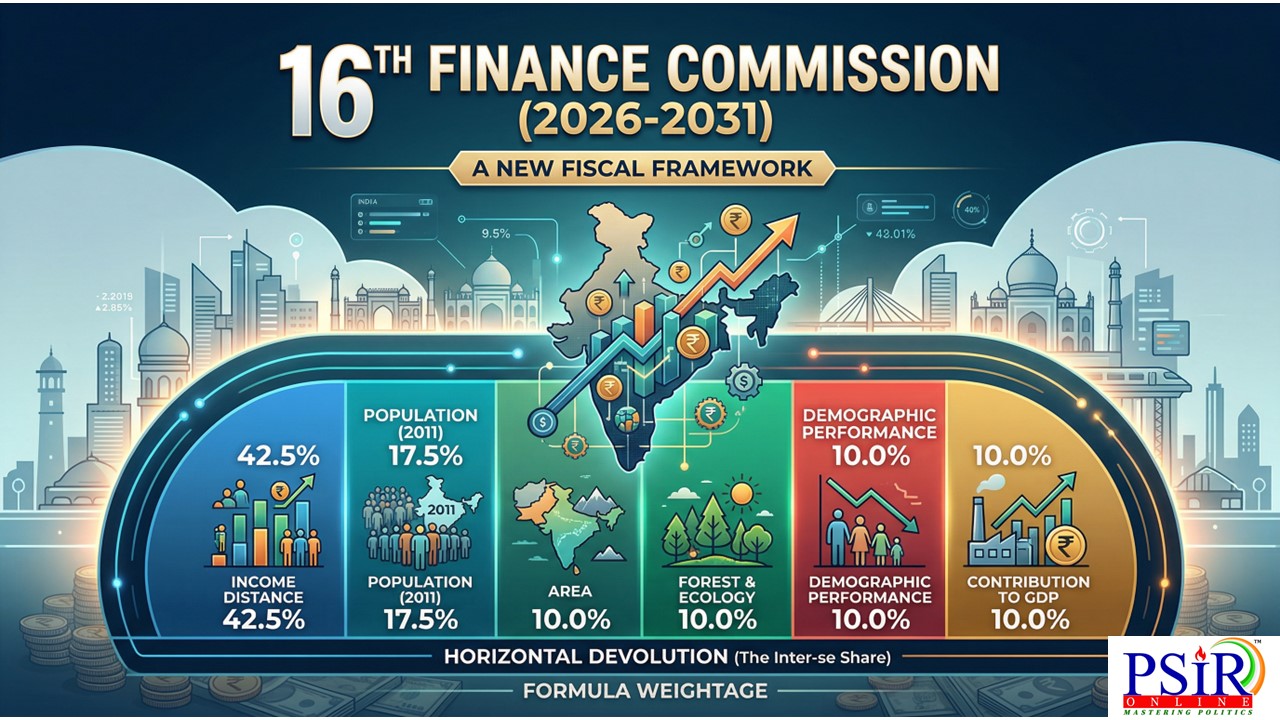
The 16th Finance Commission (16th FC), chaired by Arvind Panagariya, submitted its report for the award period 2026–2031. While tax devolution often grabs the headlines, the Commission’s recommendations on grants, fiscal discipline, and disaster management represent a major shift toward "compliance-driven" fiscal federalism.
Here is a detailed breakdown of the key recommendations
VERTICAL DEVOLUTION (41% SHARE)
NEW DEVOLUTION FORMULA: HORIZONTAL DEVOLUTION (DISTRIBUTION AMONG STATES)
The 16th FC made notable changes to how the 41% share is distributed among individual States (horizontal devolution). It uses six criteria with the following weights:
|
Criterion |
Weight (16th FC) |
Change from 15th FC |
Purpose |
|
Income Distance (per capita GSDP distance from top 3 States) |
42.5% |
Reduced from 45% |
States with lower per capita income get more (Equity). |
|
Population (2011 Census) |
17.5% |
Increased from 15% |
Larger population = higher need for services. |
|
Demographic Performance |
10% |
Reduced from 12.5%; redefined |
Rewards states that successfully controlled population (1971-2011). |
|
Area |
10% |
Reduced from 15% |
Larger land area = higher cost of governance. |
|
Forest & Ecology |
10% |
Same; expanded to include open forests + reward for increase |
Rewards states for preserving green cover/carbon sinks. |
|
Contribution to GDP |
10% |
New (replaces tax/fiscal effort) |
Rewards economic efficiency & contribution to national growth |
|
Tax and Fiscal Effort |
Do not exist |
2.5% in 15th Finance commission |
To give directional recognition to efficiency and States’ role in driving national economic growth. |
|
HOW THIS WORKS VERTICAL DEVOLUTION (CENTRE TO ALL STATES TOGETHER)
HORIZONTAL DEVOLUTION (HOW ₹4,100 IS DIVIDED AMONG 28 STATES)
So, no State will get exactly ₹146.43 (which would be equal share = 4100 ÷ 28). Uttar Pradesh might have a high "Horizontal Share" (say 17%) because of its massive population and low income. So, it would get 17% of the ₹4,100 (~₹697). Tamil Nadu might have a lower "Income Distance" but a high "Contribution to GDP" and "Demographic Performance." If its share is 4%, it gets 4% of the ₹4,100 (~₹164).
|

THE "BIG SHIFT": DISCONTINUED GRANTS
The 16th FC has simplified the grant system by abolishing three major categories that were central to the 15th FC:
LOCAL BODY GRANTS (₹7.91 LAKH CRORE)
This is the largest portion of the total ₹9.47 lakh crore grant package. It is split between Rural (₹4.35L Cr) and Urban (₹3.56L Cr) bodies.
The 80:20 Rule & Tied Funds
Three "Entry Gates" (Eligibility)
To receive any of this money, a state must fulfill three mandatory conditions:
SPECIAL URBAN RECOMMENDATIONS
These are the specific items designed to manage India's rapid urban transition.
DISASTER MANAGEMENT (₹1.56 LAKH CRORE CENTRAL SHARE)
FISCAL DISCIPLINE & STRUCTURAL REFORMS
Fiscal Deficit Caps: * Centre: Target 3.5% of GDP by 2030–31. States: Annual ceiling of 3% of GSDP.
Off-Budget Borrowing Ban: A strict recommendation to stop all off-budget borrowing and bring all existing "hidden" debt onto the official state budgets.
Power Sector (DISCOMs): Encourages privatization. States can use "Special Assistance for Capital Investment" to clear old DISCOM debts, but only after the privatization process is complete.
State PSEs: Recommended the closure of 308 inactive State Public Sector Enterprises and a "three-out-of-four-year" loss rule for reviewing others.
POSITIVES (THE STRENGTHS) OF 16TH FINANCE COMMISSION RECOMMENDATION
1. Rewards Economic Efficiency
For the first time, the Commission introduced "Contribution to GDP" (10%) as a weightage. This directly addresses the long-standing grievance of industrialized states (like Tamil Nadu and Maharashtra) that they were being "punished" for being productive. It incentivizes states to grow their economies.
2. Boosts Urban Infrastructure
The creation of the Special Infrastructure Component (₹56,100 Cr) specifically for wastewater and sewerage in mid-sized cities (10–40 lakh population) is a major positive. It recognizes that urban flooding and poor sanitation are the biggest hurdles to India's "next-level" growth.
3. Enforces Fiscal Transparency
The 16th FC is very strict on Off-Budget Borrowings. By mandating that all "hidden" state debts be brought onto the main budget, it ensures a true picture of India’s debt-to-GDP ratio. This prevents states from hiding their fiscal deficits through state-run corporations.
4. Predictability in Funding
By retaining the 41% vertical devolution share, the Commission has provided "semi-permanence" to the funding structure. This allows states to plan their 5-year development projects without the fear of a sudden drop in central tax shares.
5. Modernizes Disaster Management
The inclusion of Heatwaves and Lightning in the national disaster list is a progressive move. As climate change impacts India, states now have the legal and financial backing to use SDRF funds for these increasingly common "silent killers."
NEGATIVES (THE CHALLENGES) OF 16TH FINANCE COMMISSION RECOMMENDATION
1. Scrapping of "Safety Nets" (Revenue Deficit Grants)
The complete discontinuation of Revenue Deficit (RD) Grants is the most controversial move. States with structural disadvantages (like the Himalayan states) or high committed expenditures (like Kerala and Punjab) no longer have a "top-up" grant to cover their essential expenses after tax devolution.
2. Shrinking "Untied" Funds
The Commission has increased the "Entry Conditions" for local body grants. By making 50% of basic grants "Tied" to specific central priorities (water/sanitation), it reduces the fiscal autonomy of Panchayats and Municipalities to spend money on local needs like street lighting or local parks.
3. Ignored the "Cess and Surcharge" Issue
The 16th FC noted the states' complaints about the rising share of Cesses and Surcharges (which the Centre doesn't share) but did not make a binding recommendation to cap them. This means the "actual" divisible pool remains smaller than the "gross" tax collection, continuing the fiscal friction between Centre and States.
4. Population Data Friction
By continuing to use the 2011 Census for 17.5% weightage, the Commission continues to face criticism from states that successfully controlled their population decades ago. The "Demographic Performance" weight (10%) is seen by some states as a "small bandage on a large wound."
WHY SOUTHERN STATES LIKE TAMIL NADU CALLS THE TAX DEVOLUTION FORMULA IS INJUSTICE?
The "injustice" argument from southern states like Tamil Nadu isn't just about the money they get—it’s about the gap between what they contribute and what they receive, and the feeling that they are being penalized for their success.
1. The Population Penalty (1971 vs. 2011)
For decades, India used the 1971 Census to reward states that successfully controlled their population. Starting with the 15th FC (and continuing in the 16th), the 2011 Census is used. The Issue: Southern states successfully implemented family planning. Northern states didn't. By using 2011 data, the formula gives more money to states that failed to control population and less to those that succeeded.
2. The "Income Distance" Logic (The Equity vs. Efficiency Debate)
The formula gives the most weight (42.5%) to "Income Distance"—the gap between a state's income and the richest state's income. The Issue: Since Tamil Nadu has a high GSDP (Gross State Domestic Product), it is considered "near the top." Therefore, it gets very little money under this criteria. Tamil Nadu argues that being "productive" shouldn't mean losing out on the taxes its own citizens paid.
3. The "Cess and Surcharge" Problem
The Issue: The Centre collects a lot of money through "Cesses" (like the Swachh Bharat Cess). By law, these are not shared with states. The Injustice: Southern states contribute a huge portion of these cesses through their industries, but 100% of that money stays with the Central Government.
How the 16th Finance Commission tried to fix this?
To calm this "North vs. South" row, the 16th FC introduced a new 10% weightage for "Contribution to GDP." The Result: Despite this, Tamil Nadu's share only increased marginally (from 4.079% to 4.097%). The state government argues this "token increase" doesn't fix the fundamental imbalance where they receive less than 20 paise for every ₹1 they contribute to the Central tax pool.
|
THE MATH OF "TAX INJUSTICE": THE TAMIL NADU CASE In the discourse of Indian fiscal federalism, the primary grievance of industrialized states like Tamil Nadu is the widening gap between Contribution and Devolution. 1. The Contribution Side (9%) Tamil Nadu is the second-largest economy in India. It contributes approximately 9.1% to the direct tax collection and nearly 10% to the GST pool of the Central Government. In simple numbers: For every ₹100 the Centre collects in taxes, approximately ₹9.00 comes from the people and businesses of Tamil Nadu.
2. The Devolution Side (41% vs. 4.097%) Under the 16th Finance Commission, the vertical devolution is fixed at 41%. However, Tamil Nadu’s horizontal share (its portion of that 41%) is only 4.097%. Let’s see what happens to that ₹100 contributed by Tamil Nadu: The Retained Share: The Centre keeps ₹59 for its own expenses (Defence, Railways, etc.). The Divisible Pool: Only ₹41 is available to be shared among all 28 states. The Tamil Nadu Share: Tamil Nadu receives 4.097% of that ₹41. Hence, 41 X 0.04097 = ₹1.68
3. The "Gap" in Numbers When you compare the contribution to the return, the disparity is stark:
The Argument: For every ₹1 Tamil Nadu pays to the Central tax pool, it receives back only about 18 to 20 paise. In contrast, states like Bihar or Uttar Pradesh receive significantly more than ₹1 for every ₹1 they contribute.
|
HOW TO MAKE SOUTHERN STATES HAPPY?
1. The "Grand Bargain" on Cesses and Surcharges
This is the single biggest "pain point" for states like Tamil Nadu and Kerala.
2. Implement a "Floor Guarantee"
Southern states fear that as their population continues to shrink relative to the North, their share will drop in every future commission.
3. Reward "Second Generation" Reforms
The current formula rewards "Demographic Performance" (population control). However, southern states have already achieved this. They are now facing new challenges.
4. Matching Grants for Urban Efficiency
Since the South is more urbanized, its cities face massive pressure on infrastructure.
GS 2 Mains Practice Questions
PSIR Practise Questions