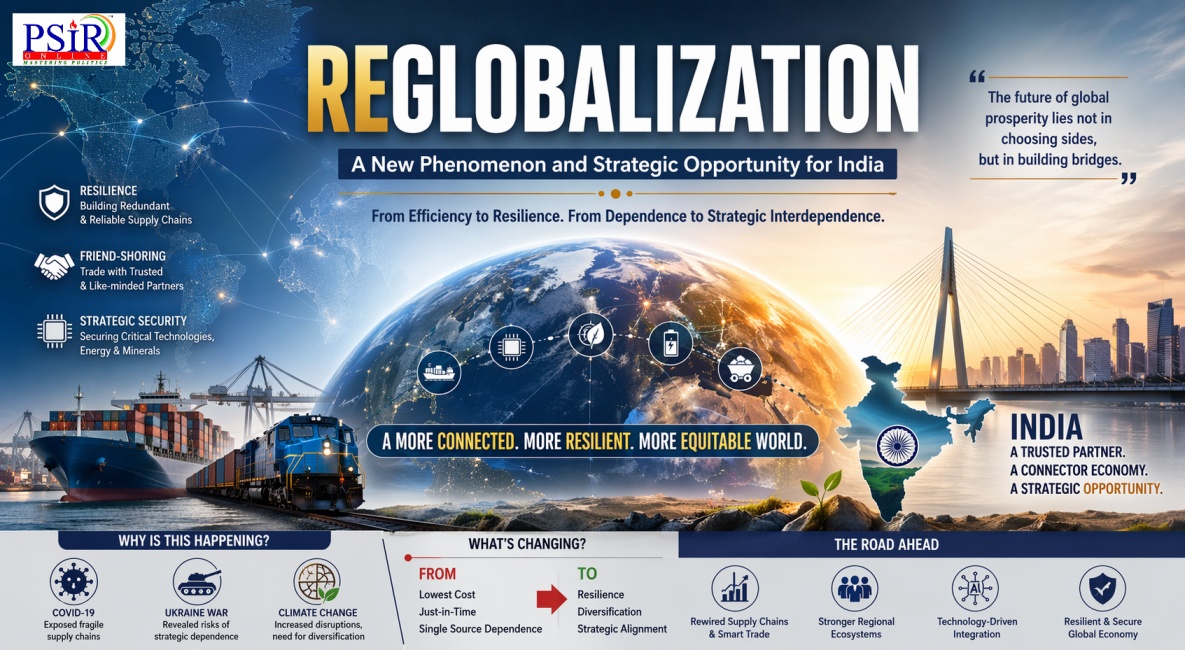
The World Economic Forum (WEF) and related analyses in early 2026 explicitly described a shift from traditional hyper-globalization (focused on pure cost efficiency, just-in-time supply chains, and maximal integration) toward "reglobalization"—a recalibration of trade, production, and finance that prioritizes resilience, national/security concerns, regional clustering, and strategic alignment alongside (rather than instead of) global connectedness.
Reglobalisation refers to the ongoing re‑arrangement and deepening of global economic integration after the setbacks and slowdowns of the 2010s and early 2020s, rather than a simple return to pre‑2008 “hyper‑globalisation.” It describes how global trade, investment, and supply‑chain networks are being reshaped—by technological change, geopolitical shifts, and new rules—while still moving toward greater interdependence, not de‑coupling.
|
SIMPLE EXPLANATION
Think of it this way: For the last 30 years, the world followed a "Shopping Mall" logic. Now, it is moving toward a "Neighborhood Safety" logic. Here is the simple breakdown of this shift from Globalization to Reglobalization.
1. The Old Way: Pure Efficiency (The Lowest Price) In the past, the only question companies asked was: "Where is the cheapest place on Earth to make this?" · The Goal: Saving money. · The Result: Your phone might be designed in the US, use chips from Taiwan, and be assembled in China. · The Risk: If one link in that long chain breaks (like a pandemic or a war), the whole world stops getting phones.
2. The New Way: Reglobalization (Safety First) Now, countries and companies realize that being "cheap" isn't enough if it isn't "safe." They are willing to pay a little more to ensure they actually get the goods. This is built on three new pillars:
A. Resilience (The Spare Tire) Instead of having just one factory in one country, companies now spread out. · Example: Instead of "Only China," a company might use "China + India + Vietnam." If one country has a problem, the others keep running. It’s like carrying a spare tire. B. Security (The "Friend-Shoring") Governments are worried about being "blackmailed" by rivals. If a country you don't get along with controls all your medicine or oil, you are in trouble. · The Shift: Countries are moving trade to "friendly" nations. The US and Europe are trading more with India because they trust the political relationship more than they trust others. C. Strategic Concerns (The Brains) Some things are too important to let others control—like Artificial Intelligence (AI) or advanced computer chips. · The Shift: Governments are bringing the "brainy" parts of production back home or to very close allies, even if it costs more.
Why is this happening? Three big "shocks" caused this: · COVID-19: Showed how easily long supply chains break. · The Ukraine War: Showed how dangerous it is to depend on a rival for energy (like Europe depended on Russian gas). · Climate Change: Extreme weather is destroying factories, so you need backups in different parts of the world.
|
KEY ELEMENTS OF THIS TRANSITION (AS FRAMED BY WEF IN JANUARY–MARCH 2026)
Architecture, not volume: Global integration isn't collapsing ("deglobalization" is seen as overstated). Instead, the structure is being rewired into a more multinodal, regionally and politically clustered network. Trade flows continue at high levels, but decisions increasingly factor in redundancy, security, and reduced vulnerability to single-point failures or geopolitical shocks.
Drivers: Geopolitical tensions, supply-chain disruptions (from recent years), industrial policy, sanctions/export controls, and a broader "weaponization" of economic tools. The WEF's Global Risks Report 2026 highlighted geoeconomic confrontation as the top near-term global risk.
Priorities shifting:
· From: Lowest-cost sourcing ("just-in-time").
· To: Resilience, "friend-shoring"/near-shoring, diversification, and security (e.g., critical technologies, semiconductors, energy, minerals).
Role of regions and "connector" economies: Regional ecosystems gain importance (e.g., more intra-regional trade blocs), while certain economies act as bridges. AI and digital tools are increasingly used to manage smarter, more intelligence-driven supply chains.
Business implications: Companies are adopting dual-track models—maintaining global scale where possible while building resilient, localized options. Over $400 billion in trade flows reportedly reshuffled in 2025 alone, with a surge in trade policy measures.
IF REGLOBALISATION CONTINUES FOR ANOTHER DECADE?
If reglobalization continues over the next decade (through ~2036), it would produce a more resilient but less efficient global economy, while accelerating a multipolar world order with stronger geopolitical blocs and rising influence for "connector" economies. This is not outright deglobalization—global trade and connectedness remain high—but a structural rewiring that prioritizes security, redundancy, political alignment ("friend-shoring"), and regional clustering over pure cost minimization. Actions in the next few years on industrial policy and supply-chain shifts will lock in patterns for decades.
Impacts on the World Economy
Continued reglobalization might deliver greater shock resistance at the expense of slower growth, higher costs, and uneven gains. Key projections and dynamics include:
· Slower global growth and productivity: IMF analyses of geoeconomic fragmentation (tariffs, trade diversion, decoupling) point to permanent global GDP losses of 0.5% or more by the early 2030s in moderate scenarios, with steeper hits (up to several percentage points) in severe decoupling cases. Baseline forecasts already show world growth settling around 3.1–3.2% annually through 2030—below pre-pandemic averages—due to suboptimal resource allocation, duplicated supply chains, and slower cross-border knowledge diffusion. WEF scenario work to 2030 highlights that volatile fragmentation paths could lead to stagnant or even negative GDP trajectories in some futures, while cooperative reglobalization + rapid AI/tech adoption could push growth above 4%.
· Higher costs and mild inflationary pressures: Friend-shoring, near-shoring, and resilience-building raise production expenses (lost efficiency from "just-in-time" to "just-in-case" models). Models estimate meaningful GDP drags from these shifts, with pass-through to prices in critical sectors (semiconductors, energy, critical minerals, green tech). Trade diversion helps some countries short-term but creates aggregate distortions and inventory volatility.
· Rewired trade and production patterns: Overall trade volumes stay robust or grow (potentially +$12 trillion by 2035 in baseline paths), but flows become more regional, intra-bloc, and politically clustered. US-China direct trade has already contracted sharply in sensitive areas; intra-alliance and connector-mediated flows rise. Corporations run "dual-track" models: global scale for non-strategic goods, localized/aligned production for high-security items. Connector economies (e.g., Mexico, Vietnam, Poland—and increasingly India) thrive as intermediaries, processing inputs and exporting to major markets.
· Sectoral and regional winners/losers:
o Winners: Tech/AI-driven resilience (smarter supply-chain management), domestic manufacturing revival in major powers, and hubs aligned with major blocs. Emerging markets as a group could still drive ~65% of global growth if they upgrade capabilities.
o Losers: Peripheral economies without strong alignment or digital infrastructure; reduced efficiency in non-critical global value chains.
o Developing regions (Africa, parts of Latin America) face uneven benefits unless they build reliability and digital trust.
Overall, the economy becomes more multinodal and selective—still interconnected, but with higher resilience to geopolitical or pandemic shocks and lower vulnerability to single-point failures.
Impacts on World Power Dynamics
Reglobalization accelerates multipolarity and turns geoeconomics into a primary arena of competition. Alliances, standards regimes, and control over critical flows (tech, finance, resources) increasingly define influence.
· Blocs and alignment matter more: Friend-shoring reinforces geopolitical clusters (US/Western-aligned vs. China-led networks, with the EU often as a semi-independent pole). Intra-bloc trade and investment deepen; cross-bloc flows slow or face barriers. This reduces the "weaponization" risks of deep interdependence but heightens bloc-on-bloc rivalry over standards, technology, and resources.
· Major players:
o United States: Retains anchoring role via demand, innovation, capital markets, and dollar dominance, but protectionism and selective disengagement shift some "global insurer" functions elsewhere. Reshoring/near-shoring bolsters domestic manufacturing and jobs.
o China: Faces headwinds from decoupling in sensitive sectors but redirects exports and builds parallel networks. It remains a central pole.
o EU: Strengthens as a regulatory and standards power; benefits from friend-shoring within its orbit.
o Emerging/middle powers (esp. India): Gain outsized leverage as "connectors" or swing states. India is particularly well-positioned—democratic alignment with the West, manufacturing push (PLI schemes), semiconductors, defense, renewables, and new trade deals could make it a major gravitational center and one of the fastest-growing large economies. By the mid-2030s, forecasts often project India approaching ~6% of world GDP and playing a pivotal bridging role.
· Multilateralism weakens; minilaterals/plurilaterals rise: Institutions like the WTO face pressure, but regional and issue-specific deals proliferate. Non-aligned countries that successfully position themselves as reliable bridges fare better.
A STRATEGIC OPPORTUNITY FOR INDIA?
India is exceptionally well-positioned to thrive in reglobalization—the shift toward resilient, security-focused, and strategically aligned trade/production/finance networks—by evolving from a cost-based outsourcing destination into a trusted "connector" hub in friend-shored global value chains (GVCs).
With its democratic credentials, demographic dividend, digital public infrastructure (DPI), and ongoing reforms, India can turn geopolitical rewiring into a structural advantage, potentially capturing a larger share of redirected FDI, exports, and high-value manufacturing while building domestic shock resistance.
The Economic Survey 2025-26 frames this as moving toward "strategic indispensability" in GVCs: from import substitution to deep, high-value integration in critical sectors. Execution speed on policy, infrastructure, and skills will determine whether India becomes a pivotal node or a peripheral beneficiary.
Core Adaptation Strategies India Must Prioritize
1. Accelerate Pragmatic Trade Diversification and FTAs Pursue a flexible, interest-based foreign policy focused on economic resilience rather than rigid blocs. Expedite FTAs with the EU, US, UK, Mexico, ASEAN upgrades, and others to secure market access, reduce tariff exposure, and attract friend-shored investment. Recent agreements (e.g., Oman CEPA, UK CETA) already show momentum; deeper integration will diversify away from over-reliance on any single market while hedging protectionism. This aligns with reglobalization's regional clustering while keeping India as a bridge economy.
2. Scale Manufacturing Capabilities in Strategic Sectors (Friend-Shoring Magnet) Build on PLI schemes, semiconductor missions, and defense procurement reforms to move beyond final assembly toward upstream value addition (APIs, components, critical minerals processing). Key focus areas:
a. Electronics/semiconductors (joining US-led secure tech initiatives like Pax Silica).
b. Critical minerals (National Critical Mineral Mission + partnerships via IMEC and Australia).
c. Green tech (renewables, green hydrogen as exportable resilience asset).
d. Auto, pharma, defense, and advanced manufacturing. Shift from pure cost arbitrage to capability advantage (quality, innovation, sustainability) to lock in "China+1" and Western friend-shoring flows (e.g., Apple’s India ramp-up already at 12–14% of iPhones).
3. Forge Targeted Strategic Partnerships for Supply Chain Resilience Leverage "trusted partner" status: deepen co-innovation with Europe (joint R&D centers in India for AI/robotics/semiconductors; long-term green energy offtakes) and the US/West for secure tech. Maintain selective engagement with China for non-strategic flows while prioritizing diversification. Expand trilateral/minilateral mechanisms like the Supply Chain Resilience Initiative (SCRI with Japan/Australia). Use DPI (India Stack/UPI) as a sandbox to scale foreign deep-tech innovations rapidly.
4. Invest Heavily in Enablers: Infrastructure, Skills, and Digital Resilience
a. Logistics & infra: Reduce costs further (already improving) and focus on multimodal flexibility, data centers, and green infrastructure.
b. Skilling & R&D: Upgrade workforce for high-value GVC roles; emphasize co-innovation over pure outsourcing.
c. Digital & sustainability: Deploy AI/digital tools for real-time supply chain risk mapping; decarbonize chains (up to 90% of emissions in some sectors) and integrate circular economy practices. Budget 2026–27 and ongoing reforms (labor laws, tax rationalization, ease of compliance) must prioritize these.
5. Embed Resilience Across Energy, Food, and Finance Continue diversified energy sourcing (e.g., Russian oil for cost stability), build strategic reserves/buffers, and promote domestic production in vulnerable areas. Adopt "just-in-case" inventory and multi-sourcing norms for critical inputs without sacrificing global integration.
Expected Outcomes and Risks
If executed well, India could see sustained 6–7%+ growth, FDI scaling beyond recent highs ($81B+ in 2024–25), export diversification (target $500B+ merchandise), and elevated geopolitical influence as a Global South bridge. It positions India as indispensable in multipolar supply chains.
Main risks: Slow reform execution, skills/infra gaps, or over-protectionism that deters integration. The Economic Survey stresses "strategic sobriety"—resilience without isolation.
Bottom line: India doesn’t need to "choose sides" in reglobalization; it must lean into its strengths as a stable, scalable, democratic connector. Prioritize speed on FTAs, critical-sector capabilities, and public-private execution. This decade’s window is open—policy agility will decide if India captures $ trillions in reshuffled flows or watches others (Vietnam, Mexico) take a bigger slice.
PRACTISE QUESTIONS FOR GS 2- MAINS
1. “Reglobalization represents a shift from efficiency-driven globalization to resilience-driven integration.” Examine the drivers and implications of this transition for global governance and economic stability.
2. Discuss how geopolitical tensions and supply chain disruptions have reshaped global trade architecture in recent years. What challenges does this pose for multilateral institutions?
3. Analyse the concept of “friend-shoring” in the context of emerging global economic order. How does it affect developing countries like India?
4. Evaluate India’s preparedness to emerge as a “connector economy” in the evolving reglobalized world order. Highlight key policy measures required.
PRACTISE QUESTIONS FOR PSIR OPTIONAL
1. “Reglobalization accelerates multipolarity and transforms geoeconomics into a central arena of power politics.” Critically examine.
2. How does the shift from hyper-globalization to reglobalization alter the nature of interdependence in international relations? Discuss with theoretical insights.
3. Analyse the role of “middle powers” like India in shaping the emerging global order under reglobalization. Can India act as a strategic bridge between competing blocs?
4. Examine the impact of reglobalization on the future of multilateralism. Does it signify the decline of global institutions or their transformation?