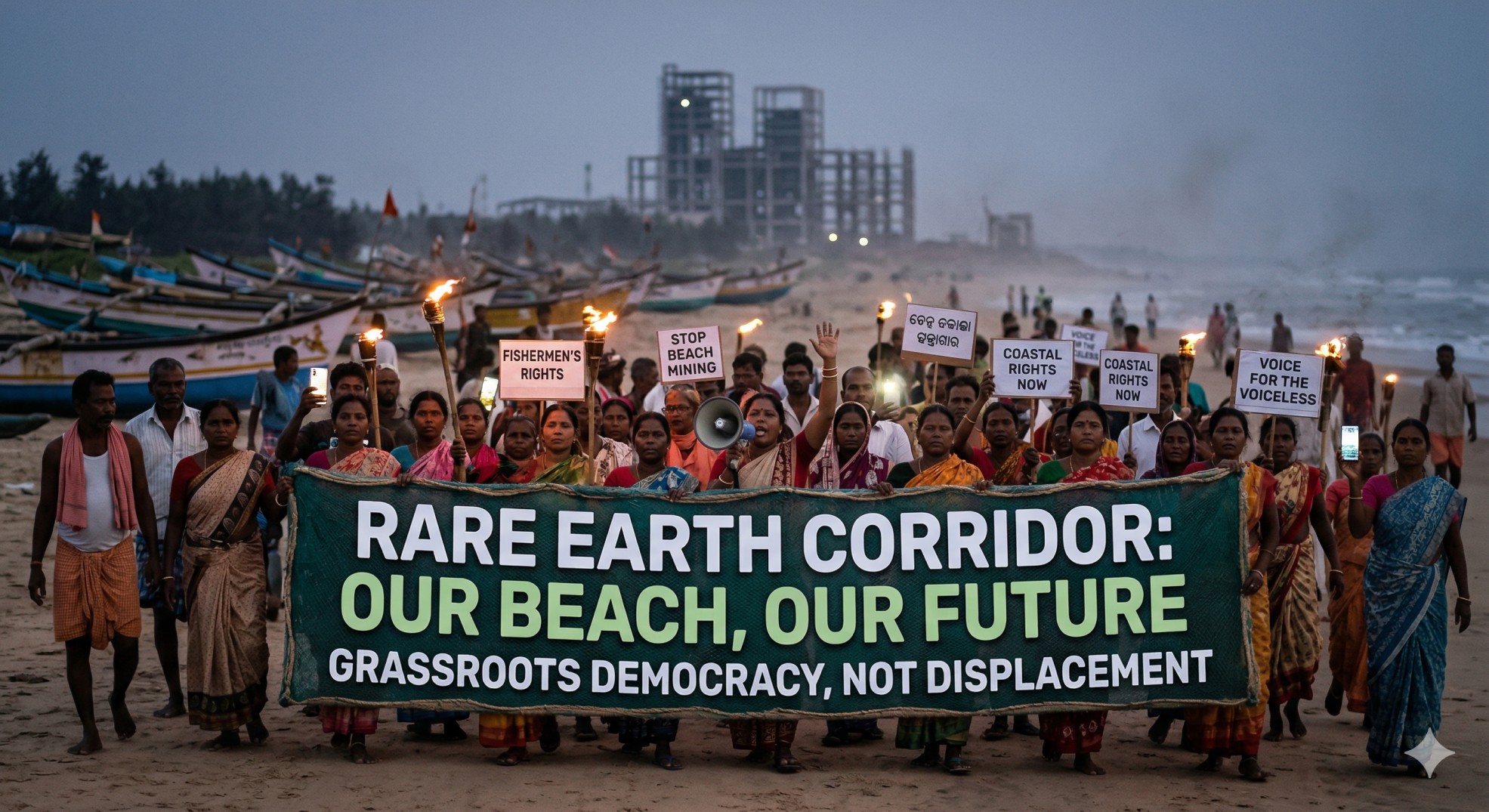
The Union Budget of February 2026 introduced a major industrial initiative: the creation of "Rare Earth Corridors" across the states of Odisha, Kerala, and Andhra Pradesh. While these corridors are intended to boost India’s green energy technology by mining critical minerals, they have immediately triggered a wave of grassroots resistance from the very communities living in these coastal belts.
The Conflict: Development vs. Livelihood
The proposed corridors are planned in areas that are rich in beach sand and offshore minerals. However, these exact locations are also the heart of India’s coastal economy, where fishing and small-scale agriculture are the primary ways of life for millions.
Local communities are resisting this proposal for three main reasons:
PSIR Perspective: Understanding the Movement
For students and followers of Political Science and International Relations (PSIR), this resistance is a classic example of contemporary political themes:
1. New Social Movements (NSM) Unlike older movements that focused mostly on labor wages, this is a "New Social Movement." It is centered on environmental identity, the right to a clean ecosystem, and the protection of a traditional way of life against state-led industrialization.
2. The "Development vs. Environment" Debate This movement highlights the ongoing tension in Indian politics between the state's push for "Strategic Autonomy" (needing rare earth minerals for high-tech defense and energy) and the Ecological Rights of the citizens.
In Support of Development (The "National Interest" View)
Proponents of the Rare Earth Corridors in Odisha, Kerala, and Andhra Pradesh argue that critical mineral extraction is essential for India’s strategic and economic future.
"I want to see India as a developed country in my lifetime. Development is the only way to end poverty." — A.P.J. Abdul Kalam
"Poverty is the greatest polluter. Unless we are able to provide employment and purchasing power... we cannot safely leave the environment to itself." — Indira Gandhi
"Energy is the engine of growth. For a nation to progress, it must secure its energy future through every available resource." — Narendra Modi
"No nation can be truly independent until it is economically self-reliant." — Sardar Vallabhbhai Patel
2. In Support of Environment (The "Ecological Rights" View)
Local grassroots movements and environmental collectives argue that the cost of this development is often borne by the most vulnerable coastal communities.
"The earth provides enough to satisfy every man's needs, but not every man's greed." — Mahatma Gandhi
"We cannot eat money. We cannot drink oil. When the last tree is cut, only then will we realize that wealth is not in the bank, but in the forest and the sea." — Sunderlal Bahuguna (Chipko Movement Leader)
"The environment is not a property we inherit from our ancestors; it is a loan we take from our children." — Medha Patkar (Narmada Bachao Andolan)
"Development without justice is just another name for exploitation. The land belongs to those who live on it and care for it." — C.K. Janu (Adivasi Activist)
3. Grassroots Democracy: The Power of Local Mobilization
The emergence of resistance against the "Rare Earth Corridors" in Odisha, Kerala, and Andhra Pradesh is a profound example of grassroots democracy in action. When local collectives and fisher unions mobilize pre-emptively, they transform from quiet residents into powerful pressure groups that challenge top-down governance.
Why Pressure Groups are Vital to a Democracy
In any robust polity, the presence of active civil society groups is essential for several reasons:
Forcing a Reconsideration of Policy
The primary strength of grassroots federalism lies in its ability to force the government to move away from one-size-fits-all policies. By asserting their rights at the local level, these groups remind the political system that substantive rights—the right to a clean environment and a stable livelihood—are just as important as the state's industrial goals.
In a true democracy, the inclusion of these diverse voices ensures that the "Changing Socio-Economic Profile" of leadership remains responsive to the actual needs of the people, rather than just the demands of global markets.
The "Rare Earth Corridor" resistance is not just a protest against mining; it is a demand for a developmental model that respects coastal ecology and community consent. As the movement grows in Odisha, Kerala, and Andhra Pradesh, it will serve as a major test for how India balances its global economic ambitions with the rights of its most vulnerable coastal populations
Practise questions for PSIR
Paper I: Political Theory and Indian Politics
Paper II: Comparative and Global Politics