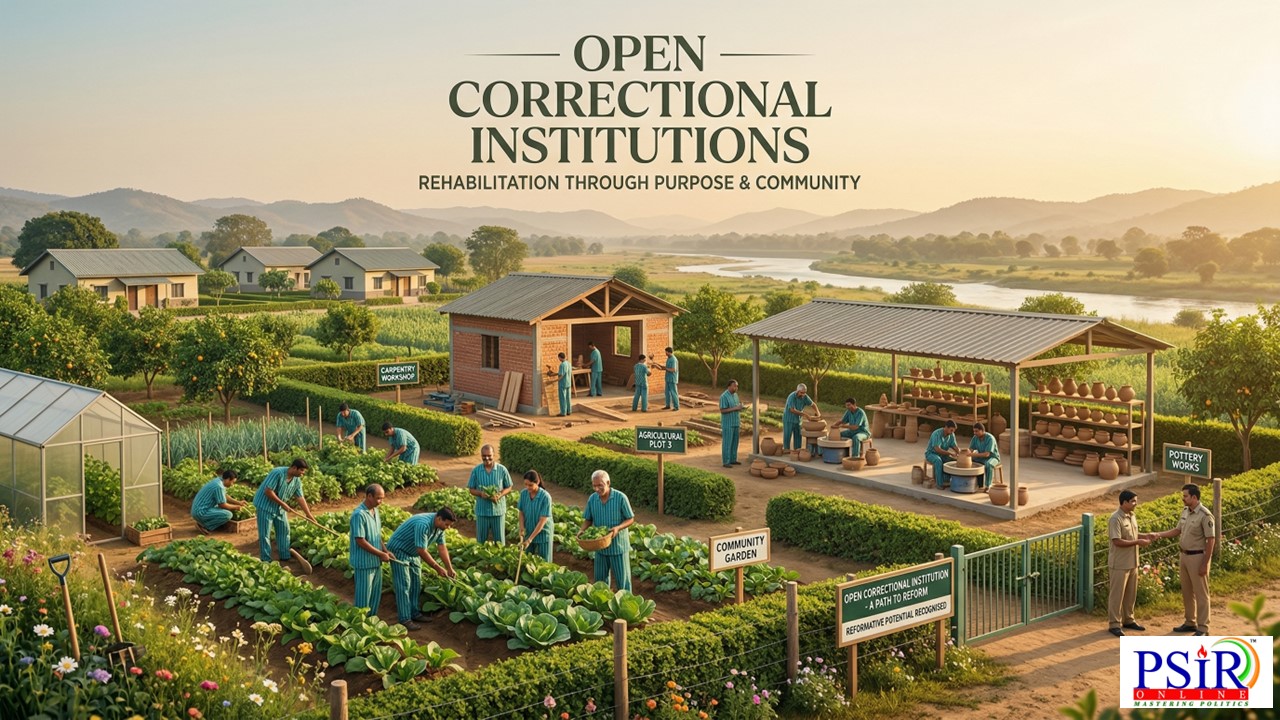
In a landmark judgment delivered on 26 February 2026 in Suhas Chakma v. Union of India (Feb 2026) case, a Division Bench of Justices Vikram Nath and Sandeep Mehta issued binding nationwide directions for the uniform governance, expansion, and reform of Open Correctional Institutions (OCIs) across India, holding that prison reform is a constitutional obligation under Articles 14, 15, and 21, not a matter of executive grace.
KEY CONSTITUTIONAL HOLDINGS
OPERATIVE DIRECTIONS ISSUED
The Court issued the following binding directions to all States and Union Territories:
|
Dimension |
Direction |
|
Establishment & Expansion |
All States/UTs must take time-bound steps to establish and expand OCIs. Existing open-air camps/prisons cannot be reduced in area or capacity under any circumstances |
|
Women's Inclusion |
States must frame policies enabling transfer of eligible women; create dedicated facilities; remove blanket exclusions; and evolve gender-sensitive eligibility norms |
|
Eligibility Criteria |
Transfer criteria must be based on conduct, self-discipline, reformative progress, and reintegration potential—not on rigid temporal thresholds (4–21 years in closed prisons) or gravity of offence alone |
|
Common Minimum Standards |
The Union of India must evolve uniform standards for: living conditions, sanitation, wages, healthcare, education, vocational training, family integration, and disciplinary procedures |
|
Skill Diversification |
Vocational training must move beyond agriculture/traditional labour to market-relevant contemporary skills to ensure post-release self-support |
|
Family Integration |
States must facilitate marriage, cohabitation, and residence of families/children within OCIs to preserve familial bonds critical for reintegration |
|
Monitoring |
High Courts were instructed to monitor compliance through suo motu writ petitions; periodic reporting is mandatory |
CRITICAL FINDINGS ON GROUND REALITY
WHAT ARE OPEN CORRECTIONAL INSTITUTIONS (OCIS)?
Open Correctional Institutions (OCIs)—commonly called Open Prisons or Open Jails—are minimum-security correctional facilities where selected prisoners serve their sentences with minimal supervision, no high walls, no barbed wire, and no armed guards. Instead of physical restraints, OCIs operate on the philosophy of self-discipline, trust, and graded liberty, allowing inmates to work, study, and even live with their families while preparing for reintegration into society.
CORE CHARACTERISTICS
|
Feature |
Closed Prison |
Open Correctional Institution |
|
Security |
High walls, barbed wire, armed guards, locked cells |
No walls/bars; perimeter marked by simple boundaries |
|
Supervision |
Constant surveillance; restricted movement |
Minimal supervision; freedom of movement within/outside premises |
|
Philosophy |
Retributive + Custodial |
Reformative + Rehabilitative |
|
Work/Education |
Limited; mostly inside prison |
External employment, vocational training, agriculture, self-employment |
|
Family Contact |
Restricted visitation hours |
Family can reside; marriage/cohabitation permitted |
|
Cost per Prisoner |
₹333.12/day (avg.) |
₹49.60/day (e.g., Rajasthan) |
HOW ARE OCIs USEFUL?
1. Decongests Overcrowded Prisons
India's prisons operate at 128% occupancy (5.5 lakh prisoners against 4.3 lakh capacity). OCIs absorb low-risk inmates, reducing pressure on closed facilities. Example: Rajasthan has shifted thousands to its 30+ open prisons, significantly easing Jaipur Central Jail's burden.
2. Dramatically Reduces Recidivism
Research shows inmates from OCIs reoffend far less than those from closed prisons. Example: Sanganer Open Prison (Rajasthan)—the world's largest—houses 500+ inmates with negligible recidivism over decades. International Parallel: Norway's Bastøy Prison (open model) has <20% recidivism vs. 60%+ in traditional prisons.
3. Cost-Effective for the Exchequer
OCIs cost 6–7 times less to operate than closed prisons due to minimal security infrastructure and prisoner self-sufficiency. Example: In Rajasthan, per-prisoner daily cost is ₹49.60 in OCIs vs. ₹333.12 in closed jails.
4. Preserves Family Bonds & Social Ties
Unlike closed prisons that isolate inmates, OCIs allow spouses, children, and elderly parents to reside within the premises, preventing family breakdown—a key driver of post-release crime. Example: Yerwada Open Jail (Pune) permits family cohabitation; children attend local schools, maintaining normalcy.
5. Skill Development & Economic Self-Reliance
Inmates engage in agriculture, dairy farming, vocational trades, and external employment, earning wages and building savings for post-release life. Example: In Nettukaltheri Open Prison (Kerala), inmates run successful organic farms, poultry units, and tailoring cooperatives, earning ₹8,000–15,000/month.
6. Improves Mental & Physical Health
Freedom from claustrophobic cells, access to open spaces, and meaningful work reduce depression, anxiety, and institutionalisation syndrome.
7. Upholds Constitutional Dignity (Article 21)
The Supreme Court in Suhas Chakma (2026) held that OCIs operationalise the constitutional promise of reformative justice, recognising that "fundamental rights do not flee the person as he enters the prison".
REAL-WORLD EXAMPLES IN INDIA
|
OCI |
Location |
Notable Features |
|
Sanganer Open Prison |
Jaipur, Rajasthan |
World's largest; 500+ inmates; agriculture + external jobs; near-zero recidivism |
|
Yerwada Open Jail |
Pune, Maharashtra |
First open jail for women (2010); family residence; vocational training |
|
Nettukaltheri Open Prison |
Thiruvananthapuram, Kerala |
Organic farming, dairy, tailoring; inmates earn wages; children study outside |
|
Poojappura Women's Open Prison |
Thiruvananthapuram, Kerala |
First women's OCI in South India (2012); focus on skill diversification |
|
Cheemeni Open Prison |
Kasaragod, Kerala |
Agriculture-based; model for family integration |
ELIGIBILITY CRITERIA FOR OPEN CORRECTIONAL INSTITUTIONS (OCIS)
Eligibility is state-specific (prisons are a State List subject), but the Suhas Chakma (2026) judgment has now mandated rationalisation of these criteria nationwide. Here's the current position:
|
Criterion |
Typical Requirement |
|
Conviction Status |
Must be a convict (not undertrial) |
|
Sentence Length |
Sentenced to ≥1 year RI/imprisonment |
|
Time Served in Closed Prison |
1/4th to 1/3rd of total sentence (varies by State); some States required 5–21 years before OCI consideration |
|
Conduct |
Good behaviour record; no disciplinary proceedings pending |
|
Age |
Usually 21–50/60 years (varies) |
|
Physical/Mental Fitness |
Must be fit for work/self-discipline |
|
Willingness |
Must voluntarily agree to OCI rules |
|
No Pending Cases |
No other case pending in court |
|
Not a Habitual Offender |
No history of repeated convictions |
|
Residence |
Some States (e.g., Rajasthan) required abode within the State |
CATEGORIES TYPICALLY EXCLUDED FROM OCIS (ACROSS MOST STATES)
The following are routinely barred:
WHO GETS TRANSFERRED?
|
Offence |
Likelihood of OCI Transfer |
Reason |
|
Murder (single instance, family dispute) |
Moderate-High (after 5–7 years good conduct) |
Not "professional"; reformative potential recognised |
|
Murder (contract killing, organised crime) |
Near Zero |
Classified as "professional/heinous" |
|
Rape (non-aggravated, first offence) |
Low-Moderate (highly discretionary) |
Moral turpitude; public sensitivity |
|
Gang Rape / Aggravated Rape |
Zero |
Statutorily/practically barred |
|
POCSO (any offence) |
Zero |
Categorically excluded nationwide |
|
NDPS (small quantity, personal use) |
Moderate (after de-addiction progress) |
Seen as health issue + reform possible |
|
NDPS (commercial trafficking) |
Zero |
Grave offence; statutory bar |
|
Theft/Cheating (non-habitual) |
High (after 1–2 years) |
Low-risk; reformative model fits |

POLITICAL INFLUENCE & CORRUPTION IN OCI TRANSFERS
Yes, this is a documented reality. Multiple High Courts and investigative reports have confirmed:
|
Evidence |
Details |
|
Madras HC (Jan 2025) |
Expressed shock over "alarming corruption" in Tamil Nadu prisons; ordered DVAC investigation after officials were caught siphoning funds and granting undue privileges to influential convicts |
|
Karnataka (Nov 2025) |
Former DGP Bhaskar Rao alleged "cash-for-transfers" syndicate in Bengaluru's Parappana Agrahara; political connections determined who got open prison benefits |
|
NCRB Study (2024) |
Found that inmates with influential backgrounds or money received special privileges, leading to inequality and undermining justice. |
|
V.K. Sasikala Case (2017) |
AIADMK leader granted luxurious accommodation in Bengaluru Central Jail; exposed how political power manipulates prison administration. |
The Suhas Chakma (2026) Response:
The SC explicitly acknowledged this risk and mandated:
DO REPEAT OFFENDERS USE OCIS AS AN "ESCAPE ROUTE"?
Escape Statistics: Lower Than Closed Prisons
|
Metric |
Open Prisons |
Closed Prisons |
|
Escape Rate |
~2–3% annually |
~5–7% annually |
|
Recapture Rate |
>90% within 48 hours |
~60–70% |
|
Recidivism (within 1 year) |
~10% (NCRB estimate) |
~25–30% |
Key Cases:
Why Escapes Are Rare:
DO THEY "ENJOY" EASY LIFE AND REOFFEND?
Reality Check: OCI Life Is NOT "Easy"
|
Aspect |
Perception |
Ground Reality |
|
Freedom |
"Luxury resort" |
Must report for roll call twice daily; absence = immediate warrant |
|
Work |
"Leisure" |
Mandatory 8–10 hours of labour (agriculture, construction, factory work) |
|
Wages |
"Free money" |
Earn ₹200–500/day; 60–70% deducted for maintenance, victim compensation, family support |
|
Discipline |
"No rules" |
Strict code of conduct; any violation = immediate transfer back to closed prison |
|
Surveillance |
"Unmonitored" |
Regular police verification; employers report daily conduct |
Recidivism Data: OCIs Reduce Reoffending
|
Study |
Finding |
|
NCRB (2024) |
10% recidivism from OCIs vs. 25–30% from closed prisons |
|
Rajasthan Govt. Review (2023) |
<5% recidivism among Sanganer alumni over 20 years |
|
Kerala Study (2022) |
Nettukaltheri graduates: 93% self-employed or employed; 0% reconvicted in 5-year follow-up |
|
International Parallel |
Norway's Bastøy (open): 16% recidivism vs. 60% in traditional prisons |
Why Recidivism Is Lower:
SAFEGUARDS AGAINST MISUSE (EXISTING + 2026 SC ENHANCEMENTS)
Pre-2026 Safeguards
Suhas Chakma (2026) Enhancements
|
New Safeguard |
How It Prevents Misuse |
|
Conduct-Based, Not Time-Based |
Prevents "waiting out" the system; only genuinely reformed qualify |
|
High Court Monitoring |
Reduces political interference; periodic judicial scrutiny of transfers |
|
Common Minimum Standards |
Uniform eligibility across States; reduces arbitrary discretion |
|
Gender-Sensitive Norms |
Prevents male-dominated committees from excluding women arbitrarily |
|
Skill Diversification Mandate |
Ensures inmates gain marketable skills, not just agricultural labour |
When the System Fails: Documented Lapses
|
Case |
What Went Wrong |
Lesson |
|
Yerawada Escape (2024) |
Murder convict fled; lax evening roll call |
Need stricter surveillance, not abolition of OCIs |
|
Karnataka "Cash-for-Transfers" (2025) |
Politicians sold OCI slots to wealthy convicts |
Judicial monitoring essential (now mandated by SC) |
|
Tamil Nadu Corruption (2025) |
Officials granted privileges to influential inmates |
Transparency + DVAC oversight required |
BOTTOM LINE
"Open prisons are not an escape from punishment, but an escape into responsibility." — Justice Vikram Nath, Suhas Chakma v. Union of India (2026).
The system is imperfect, but the data overwhelmingly supports OCIs as a net positive for public safety, fiscal prudence, and constitutional morality.
PRACTISE QUESTIONS FOR GS Paper II
Q1. "Fundamental rights do not flee the person as he enters the prison." In light of the Supreme Court's judgment in Suhas Chakma v. Union of India (2026), examine how Open Correctional Institutions operationalise Article 21. Do the Court's directions for uniform governance strike an appropriate balance between reformative justice and public safety? (15 marks, 250 words)
Q2. Prisons are a State List subject under Entry 4 of List II. However, the Supreme Court in Suhas Chakma (2026) issued binding nationwide directions for the expansion and standardisation of Open Correctional Institutions. Critically analyse whether this judicial intervention undermines cooperative federalism or fulfils a constitutional obligation that States have failed to discharge. (15 marks, 250 words)
Q3. The systematic exclusion of women prisoners from Open Correctional Institutions has been held violative of Articles 14, 15, and 21. Discuss the structural and administrative barriers that have kept women out of OCIs. How do the 2026 Supreme Court directions seek to transform OCIs into gender-inclusive reformative spaces? (10 marks, 150 words)
Q4. Recent reports of "cash-for-transfers" syndicates and political interference in OCI admissions expose the vulnerability of discretionary prison administration. In this context, evaluate the efficacy of the Supreme Court's mandate for High Court monitoring and Common Minimum Standards. Can judicial oversight alone prevent the capture of reformative institutions by vested interests? (15 marks, 250 words)
PRACTISE QUESTIONS FOR PSIR OPTIONAL
Q1. Contrast the retributive, deterrent, and reformative theories of punishment. How do Open Correctional Institutions embody the reformative ideal as articulated by Jeremy Bentham and Mahatma Gandhi? Critically examine whether the Suhas Chakma (2026) judgment marks a paradigm shift from "prison as punishment" to "prison as correction" in Indian penal philosophy. (20 marks, 300 words)
Q2. Trace the evolution of prisoners' rights jurisprudence in India from Sunil Batra v. Delhi Administration (1978) to Suhas Chakma v. Union of India (2026). How has the Supreme Court expanded the scope of Article 21 to include the right to reformative incarceration? Discuss whether this judicial activism represents "governance by judiciary" or a necessary correction of executive apathy. (20 marks, 300 words)
Q3. Despite proven benefits—6–7 times lower costs, negligible recidivism, and family preservation—Open Correctional Institutions remain severely underutilised (6–44% occupancy) in India. Analyse the administrative, political, and behavioural bottlenecks that have impeded OCI expansion. How do the 2026 Supreme Court directions address these implementation gaps through performance monitoring, standardisation, and accountability mechanisms? (20 marks, 300 words)
Q4. Compare India's Open Correctional Institutions with Norway's Bastøy Prison and the UK's Open Prison Estate. What lessons can India draw from international models regarding eligibility criteria, skill diversification, and post-release reintegration? Critically assess whether the Suhas Chakma judgment aligns Indian prison policy with the UN Nelson Mandela Rules (2015) and Bangkok Rules (2010). (15 marks, 250 words)