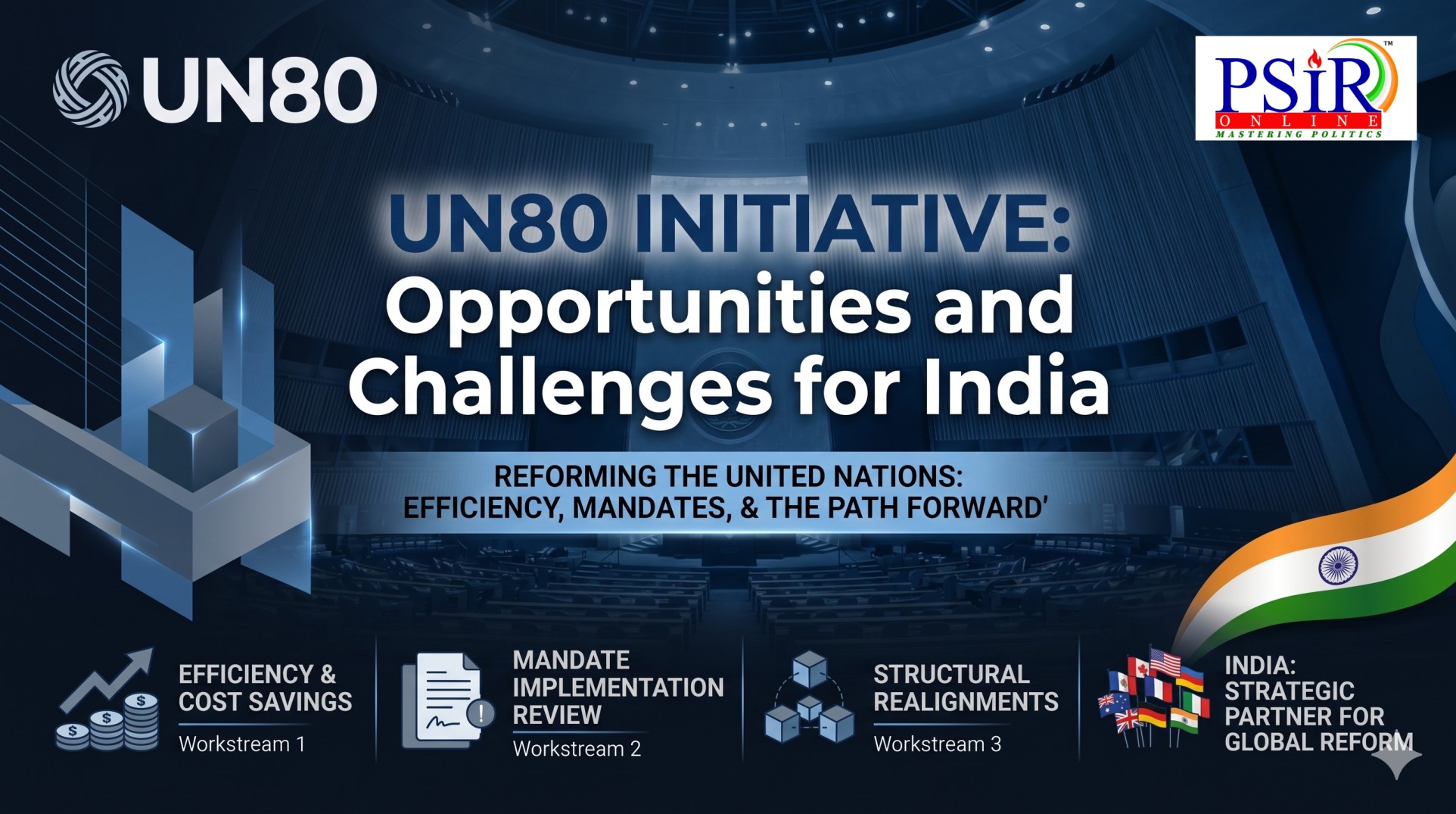
The UN80 Initiative was launched by UN Secretary-General António Guterres in March 2025 to mark the United Nations' 80th anniversary (founded in 1945). It is a comprehensive, system-wide reform effort aimed at making the UN more agile, efficient, integrated, and fit for purpose in the 21st century.
It is not a single proposal from February 2026, but an ongoing initiative with multiple workstreams. In February 2026, the UN General Assembly received briefings and updates on its progress, particularly on humanitarian reforms and other areas.
WHY THE UN80 INITIATIVE WAS LAUNCHED?
The main reasons include:
· Tightening resources and financial pressures: The UN has faced a persistent liquidity/cash crisis for years, with member states not paying contributions in full or on time. This has strained operations, delayed payments, and forced budget adjustments (e.g., significant cuts proposed for the 2026 programme budget). UN80 seeks efficiencies to mitigate these impacts, though it is not intended as a direct solution to the funding crisis.
· Growing inefficiencies and bureaucracy: The UN system has accumulated thousands of mandates (tasks from member states), leading to overlaps, duplication, fragmentation across 100+ entities, and excessive red tape. This reduces effectiveness and value for money.
· Changing global context: Multilateralism is under strain due to geopolitical tensions (e.g., conflicts in Ukraine and Gaza), rising conflicts, climate change, inequality, technological disruptions, and declining trust in international institutions. The UN needs to adapt to deliver better on peace, development, human rights, and humanitarian needs amid these "polycrises."
· Opportunity of the 80th anniversary: It provides a symbolic moment for self-reflection and ambitious reform to reaffirm the UN's relevance, build on prior efforts (like the 2024 Pact for the Future and UN 2.0), and ensure it remains accountable to member states and effective for people.
KEY ELEMENTS OF THE UN80 REFORM
The initiative is structured around three main workstreams (with an overall Action Plan released in late 2025 containing around 87 actions across 31 work packages):
1. Workstream 1: Efficiency and Cost Savings (focus on the Secretariat and budget)
a. Significant budget cuts and staff reductions for the 2026 programme budget (e.g., roughly 15–20% reductions in some areas, including potential thousands of job cuts across the UN system).
b. Streamlining operations, consolidating services (HR, finance, procurement), centralizing payroll, and relocating some functions to lower-cost locations.
c. This was reflected in the revised 2026 budget proposals and adopted elements in late 2025/early 2026.
2. Workstream 2: Mandate Implementation Review
a. Reviewing and streamlining the thousands of mandates (instructions from member states) that guide UN work, to reduce duplication, outdated tasks, and bureaucracy.
b. A landmark General Assembly resolution on this was adopted in March 2026, strengthening how mandates are created, implemented, and reviewed.
3. Workstream 3: Structural and Programme Realignments
a. Exploring mergers or consolidations of UN entities (e.g., potential merger of UN Women and UNFPA for gender and reproductive health work; reviews of training/research bodies; integration in development/operations like UNDP-UNOPS).
b. Reforms in specific areas such as humanitarian action (including a proposed New Humanitarian Compact to overhaul the strained humanitarian system), peace operations, development, human rights, data, technology, and shared services.
c. Updates on these were briefed to the General Assembly on 27 February 2026, including progress on humanitarian streamlining and training/research reforms.

FEBRUARY 2026 DEVELOPMENTS
· On 27 February 2026, the General Assembly was briefed on advancements in the UN80 Initiative. Key focus areas included:
o Proposals for a New Humanitarian Compact to make humanitarian support more efficient and effective.
o Potential mergers or reforms of UN training and research bodies.
· This was part of ongoing updates on the broader Action Plan, with the initiative entering more of a "delivery phase" in early 2026.
|
KEY FACTS |
|
|
Aspect |
Details |
|
Launch Date |
March 2025 (by Secretary-General António Guterres) |
|
Core Objective |
Make the UN more agile, efficient, cost-effective, and fit for 21st-century challenges |
|
Main Drivers |
Financial/liquidity crisis, inefficiencies & duplication, geopolitical tensions, declining multilateral trust |
|
Three Workstreams |
1. Efficiency & cost savings (e.g., budget cuts, relocation, streamlining) 2. Mandate implementation review (reduce overlaps/outdated tasks) 3. Structural & programme realignments (possible mergers, consolidations) |
|
Scope |
System-wide (Secretariat + funds, programmes, specialized agencies) |
|
Key Actions |
~87 actions in Action Plan; significant 2026 budget reductions (15-20% in some areas); reviews of thousands of mandates |
|
Timeline |
Launched 2025; Action Plan 2025; delivery phase & GA briefings in 2026; ongoing into 2026+ |
|
Not a Solution for |
Fully resolving the UN's financial crisis (it helps mitigate impacts) |
|
Expected Outcomes |
Better value for money, reduced bureaucracy, sharper impact, renewed relevance of multilateralism |
POTENTIAL BENEFITS OF UN80 INITIATIVE
· Greater efficiency and cost savings — Streamlining operations, reducing duplication, consolidating back-office functions (HR, finance, procurement), centralizing payroll, and relocating some roles to lower-cost locations help the UN do more with limited resources amid a severe financial/liquidity crisis.
· Reduced bureaucracy and overlaps — Reviewing thousands of mandates (Workstream 2) and adopting a landmark General Assembly resolution in March 2026 to improve how mandates are created, implemented, and reviewed eliminates outdated tasks and fragmentation across 100+ UN entities.
· Improved coherence and agility — Workstream 3 promotes better integration across peace, development, humanitarian, and human rights pillars (e.g., New Humanitarian Compact to simplify emergency responses, integrate supply chains, and cut red tape), making the UN more responsive to crises like conflicts, climate shocks, and displacement.
· Higher accountability and impact — Focus on data, technology, shared services, and results-oriented delivery aims to make the UN more transparent, accountable to taxpayers and member states, and better at delivering on the SDGs and people-centered outcomes.
· Long-term modernization — It builds on previous efforts (Pact for the Future, UN 2.0) and introduces tools like a UN System Data Commons and Technology Accelerator, potentially making the organization more future-ready and digitally enabled.
· Opportunity for renewal — The 80th anniversary provides a symbolic push to reaffirm multilateralism’s relevance in a polycrisis world, with some progress already visible (e.g., over 80% of early Action Plan milestones completed by April 2026).
CRITICISMS/RISKS OF UN80 INITIATIVE
· Primarily driven by austerity rather than vision — Many view it as a reactive cost-cutting exercise (15–20% budget reductions in 2026, ~6,900–20% staff cuts overall) forced by funding shortfalls and delayed contributions, rather than a bold transformation. It risks becoming “less with less” instead of “more with less.”
· Disproportionate impact on core mandates — Cuts have hit the already underfunded human rights pillar hardest (e.g., significant job losses at OHCHR, reduced monitoring missions, scaled-back presence in conflict zones), raising fears of weakened investigations, accountability for abuses, and balance among the UN’s three pillars (peace/security, development, human rights).
· Harm to staff and operations — Large-scale layoffs, relocations (e.g., out of New York/Geneva), hiring freezes, and low morale affect field-level and national staff most. Critics say senior management is often protected while working-level expertise is lost, potentially slowing responses in humanitarian crises.
· Risk of reduced effectiveness on the ground — Potential mergers (e.g., UN Women and UNFPA), recentralization in humanitarian action, and deprioritization of areas like gender equality, development (SDGs), and climate could lead to slower crisis response, less local actor involvement, and diminished technical assistance—especially worrying for Global South countries.
· Lack of deeper structural/political reform — UN80 focuses on internal efficiencies but avoids tougher issues like reforming the Security Council, fixing the funding architecture (e.g., over-reliance on earmarked donations), or addressing geopolitical paralysis. Some call it the “wrong answer to the right question”—managerial reshuffle rather than true reinvention.
· Transparency and consultation concerns — Staff unions, civil society, and some member states criticize insufficient consultation, rushed timelines, and limited transparency, which could undermine buy-in and long-term success.
· Potential for unintended long-term costs — Short-term “quick fixes” (e.g., mergers for savings) might create new inefficiencies, reduce specialized expertise, or weaken the UN’s ability to tackle complex, intergenerational challenges like inequality and AI disruptions.

IMPACT ON INDIA
India, as a major developing country, largest democracy, significant contributor to UN peacekeeping, and a key voice of the Global South, has engaged actively with the UN80 process. India supports the initiative for making the UN more efficient but repeatedly stresses that it must not be limited to cost-cutting and should serve as a catalyst for deeper political and structural reforms, especially UN Security Council (UNSC) expansion.
India's Official Position
India has stated:
· UN80 is a welcome and essential step to make the UN relevant for future challenges.
· It should not be reduced to cost efficiencies only.
· It must be used as a catalyst to revitalize all principal organs of the UN, including initiating text-based negotiations on Security Council reform.
· Institutional knowledge and expertise vital for developing countries (including India) should be strengthened, not diminished.
· India aligns with G77 + China on many points while adding its national emphasis on deeper reform.
Positive impacts/ opportunities for India
· Opportunity to push for comprehensive UN reform — India has consistently used UN80 briefings and statements to link internal efficiency reforms with the long-standing demand for UNSC reform (permanent seat for India as part of G4). It positions UN80 as a platform to make the UN more representative, credible, and effective for the 21st century.
· Potential efficiency gains in UN operations in India — Streamlining of UN Country Teams, reduced duplication, and better use of technology/data could make UN agencies (UNDP, UNICEF, UNFPA, WFP, etc.) more agile and cost-effective in supporting India's development priorities — SDGs, climate action, digital public infrastructure, poverty reduction, and humanitarian assistance.
· Stronger focus on outcomes and impact — India welcomes the mandate review (Workstream 2) and emphasis on results over activities. This aligns with India's own emphasis on "outcome-oriented" development cooperation and could improve the quality of technical assistance received from the UN system.
· Leadership role for Global South — India has used the UN80 discussions to amplify voices of developing countries, advocating that reforms should protect development mandates and not disproportionately cut support for Global South priorities
Negative impacts/ Challenges for India
PRACTISE QUESTIONS FOR GS 2 MAINS
1. “The UN80 Initiative reflects an attempt to make multilateral institutions more efficient, but risks being reduced to a cost-cutting exercise.”
Critically examine.
2. Discuss the key features of the UN80 reform initiative. How far can mandate review and structural realignment improve the effectiveness of the United Nations?
3. Evaluate the implications of the UN80 Initiative for developing countries, particularly in the context of humanitarian delivery and development assistance.
4. India has supported the UN80 Initiative but emphasized deeper structural reforms. Analyse India’s position and its broader vision for UN reform.
PRACTISE QUESTIONS FOR PSIR OPTIONAL
1. “UN80 is a managerial reform rather than a structural transformation of global governance.”
Examine this statement in the context of contemporary debates on multilateralism.
2. Critically analyse the political economy behind the UN80 Initiative. To what extent is it shaped by financial constraints rather than normative commitments?
3. How does the UN80 Initiative reflect the crisis of multilateralism in a ‘polycrisis’ world? Discuss with reference to institutional reform theories.
4. Assess whether internal institutional reforms like UN80 can address the legitimacy deficit of the United Nations without reforming power structures such as the Security Council.