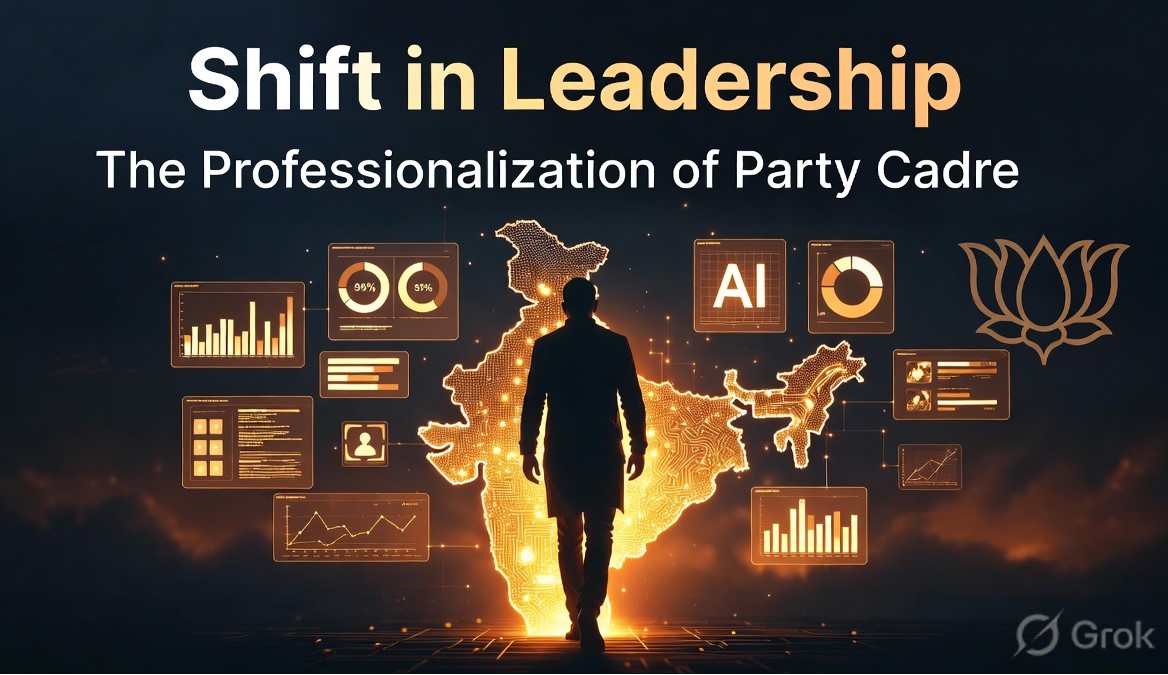
In the annals of Indian political history, February 2026 stands as a watershed moment when major national parties embarked on a deliberate “structural overhaul” of their organisational architecture. This shift, often termed the “professionalization” of party cadre, marks a transition from the traditional reliance on ideologically committed grassroots workers (karyakartas) to a new model dominated by technocrats, data scientists, and management professionals.
The appointment of Nitin Nabin—a 45-year-old dynamic leader from Bihar with a proven track record as a five-term MLA and state minister—as the national president of the Bharatiya Janata Party (BJP) in January 2026 exemplifies this paradigm. Prime Minister Narendra Modi’s public endorsement of Nabin as the party’s “millennial boss” underscored the intent to infuse youthful energy and professional acumen into the world’s largest political organisation. Similar trends are discernible in the Indian National Congress (INC) and even regional outfits, where data-driven campaigning is increasingly eclipsing conventional booth-level mobilisation.
From a PSIR perspective, this 'professionalization' reflects the global trend toward electoral-professional parties (as per Angelo Panebianco's framework), where parties move away from mass-based mobilisation to professional management and consultant-driven strategies to optimise electoral outcomes in a competitive, digital democracy.
Historical Evolution of Party Organisation
Indian political parties have historically been “parties of integration” rather than mere electoral machines. The Congress, during the freedom struggle and early post-Independence decades, drew strength from mass movements and grassroots satyagrahis. The BJP’s precursor, the Jana Sangh, and later the BJP itself, built an unparalleled cadre network through the Rashtriya Swayamsevak Sangh (RSS) shakhas, emphasising ideological indoctrination and door-to-door outreach. Even regional parties like the Dravida Munnetra Kazhagam (DMK) or Samajwadi Party relied on caste-based social networks and local leaders for mobilisation.
The seeds of professionalization, however, were sown earlier. Rajiv Gandhi’s 1980s experiment with “computer boys”—a cohort of young technocrats tasked with modernising the Congress through data collection and computerisation—represented an embryonic attempt at technocratic management. The real acceleration occurred post-2014 under the BJP’s stewardship. Amit Shah’s tenure as party president (2014-2020) institutionalised booth-level micro-management through apps like Saral, voter databases, and precise targeting. By 2026, this model has matured into a full-scale professional overhaul across parties.
Drivers of the Shift
Several structural factors have propelled this change.
First, India’s digital revolution: with over 900 million internet users and smartphones penetrating even semi-urban and rural pockets, social media has become the new battleground.
Second, an increasingly aspirational and young electorate demands evidence-based governance narratives rather than emotive rhetoric alone.
Third, the competitive federal landscape—marked by coalition compulsions and high-stakes state elections—has made precision campaigning a necessity. The proliferation of political consultancies has also been a key driver, providing the expertise and tools for data-driven operations.
Finally, the entry of professionally trained individuals (engineers, MBAs, data analysts) into politics reflects the broader “technocratic populism” of the Modi era, where governance is projected as efficient problem-solving rather than ideological contestation.
Manifestations and Key Examples
The February 2026 overhaul is most visible in leadership choices and campaign strategies.
BJP’s Technocratic Turn: Nitin Nabin’s elevation is not merely generational; it signals a preference for leaders adept at organisational management over pure ideological veterans. Under his stewardship, the party has rolled out AI-driven strategies for the 2026 state assembly polls in West Bengal, Tamil Nadu, Kerala, Assam, and Puducherry. “Assembly charge sheets” and hyper-targeted messaging—focusing on youth employment and women’s security—are crafted using voter-profile analytics. The emphasis has shifted from traditional RSS-style cadre mobilisation to professional teams handling data analytics, content creation, and social-media warfare. Booth-level karyakartas remain important but are now supplemented (and sometimes directed) by dashboards and performance metrics.
Congress and the Professional Consultant Model: The INC, though trailing, has increasingly outsourced strategy to professional agencies. The influence of political strategists such as Prashant Kishor and his Indian Political Action Committee (I-PAC) is illustrative. Kishor’s data-centric campaigns have been deployed across parties—from the Congress’s 2017-2022 experiments in Punjab and Rajasthan to non-Congress outfits. In early 2026, the Congress too initiated internal reforms, appointing professionals with backgrounds in technology and management to key organisational posts, prioritising digital outreach and opinion-poll-driven ticket distribution over traditional Pradesh Congress Committee hierarchies.
AAP and Regional Precedents: The Aam Aadmi Party (AAP) pioneered this model from its inception, blending volunteerism with app-based grievance redressal and data analytics. Its success in Delhi and Punjab demonstrated that professional management could scale volunteer energy. Other regional parties, such as the YSR Congress Party (YSRCP) in Andhra Pradesh and the Trinamool Congress (TMC) in West Bengal, have adopted similar tools—voter databases, sentiment analysis via social media, and targeted digital advertising—reducing dependence on traditional caste or regional satraps.
The Role of Political Consultants in Electoral Success
A key manifestation of this professionalization is the critical role played by political consultants in driving electoral success. The Indian Political Action Committee (I-PAC), founded by Prashant Kishor, has been instrumental in several electoral triumphs by leveraging data-driven strategies and professional campaign management. For instance, I-PAC's involvement helped the YSRCP secure a resounding victory in the 2019 Andhra Pradesh Assembly elections through precise voter targeting and the TMC to successfully defend its government in West Bengal in 2021 by countering opposition narratives with tailored digital campaigns. Likewise, consultancies like Voice of Commons have emerged as important players, providing similar data analytics and strategy services that have contributed to electoral successes for various parties by optimising campaign resources and enhancing voter engagement in a cost-effective manner.
This consultant-led approach complements the internal cadre professionalization, allowing parties to achieve higher electoral ROI in the 2026 context and beyond.
Across these examples, the common thread is the elevation of “technocrat-presidents” or professional office-bearers who treat party organisation as a corporate enterprise: measurable outcomes, key performance indicators (KPIs), and return on investment (ROI) in votes per rupee spent on digital campaigns.
The Merits of Technocratic Professionalization
Beyond the immediate tactical wins, the infusion of technocratic expertise changes the "DNA" of a political organization:
Smarter Planning: Instead of guessing, parties use data to understand what voters actually want.
New Ideas: Young professionals bring cool tools like AI and apps to make the party run faster and better.
Better People: It invites smart people (like engineers or managers) into politics who used to think politics was "dirty."
Saving Money and Time: They use business tricks to make sure every dollar and every hour is spent wisely.
Practical Solutions: These leaders focus on "what works" rather than just making angry speeches.

The Challenges of the Technocratic Shift
The "professional" veneer can sometimes mask deeper systemic vulnerabilities:
Upsetting Old Members: The "old-school" workers who have been loyal for years may feel ignored and stop helping.
Losing the Human Touch: If you only look at computer screens, you might forget the real struggles of poor or rural people.
High Costs: Hiring expensive consultants makes politics a game for the rich, which isn't fair for everyone.
No "Soul": If a party only does what the data says, they might lose their core beliefs. They become like a hollow company instead of a group with a mission.
|
TECH EXPERTS VS. TRADITIONAL LEADERS |
||
|
Feature |
Tech/Professional Way |
Traditional Way |
|
Main Goal |
Use data to win |
Stick to their beliefs |
|
How they talk |
Social media and ads |
Big rallies and meetings |
|
Decision Style |
Based on reports |
Based on feelings and history |
|
Loyalty |
Loyalty to the "job" |
Loyalty to the "cause" |
Implications for Indian Democracy
This professionalization is reshaping the party system. Internal democracy may suffer as decision-making centralises in data rooms rather than organisational elections. Federalism could be indirectly affected, as national strategies override state-specific nuances. On the positive side, it may professionalise governance, leading to better policy delivery. However, if unchecked, it could exacerbate the “democratic deficit” by privileging those with access to technology and capital over committed grassroots workers, and raise questions about the influence of unelected consultants in a democratic setup.
Way Forward
The professionalization of party cadre is inevitable in a digital age, but it must not become an end in itself. Parties need a hybrid model: retaining the ideological depth and mass connect of traditional karyakartas while harnessing the precision of technocrats and consultants. Institutional safeguards—greater transparency in data usage, regulation of political consultancies, and mechanisms to protect internal democracy—are essential. As India prepares for future electoral battles, the true test of this shift will lie not in winning elections through algorithms, but in strengthening the democratic fabric through inclusive, accountable, and people-centric leadership.
In sum, the February 2026 overhaul reflects a pragmatic response to contemporary realities. Whether it heralds a more efficient democracy or a technocratic oligarchy within parties will depend on how deftly leaders like Nitin Nabin and their counterparts balance professionalism with the enduring spirit of grassroots politics. The stakes, for the world’s largest democracy, could not be higher.
PSIR Optional (Paper I – Indian Government & Politics) Practice Questions
1 1. In the light of Angelo Panebianco’s framework of “electoral-professional parties”, critically analyse the recent “structural overhaul” and professionalization of cadre in the BJP, Congress and regional parties. How does this reflect a global trend in party organisation? (20 marks | 300 words)