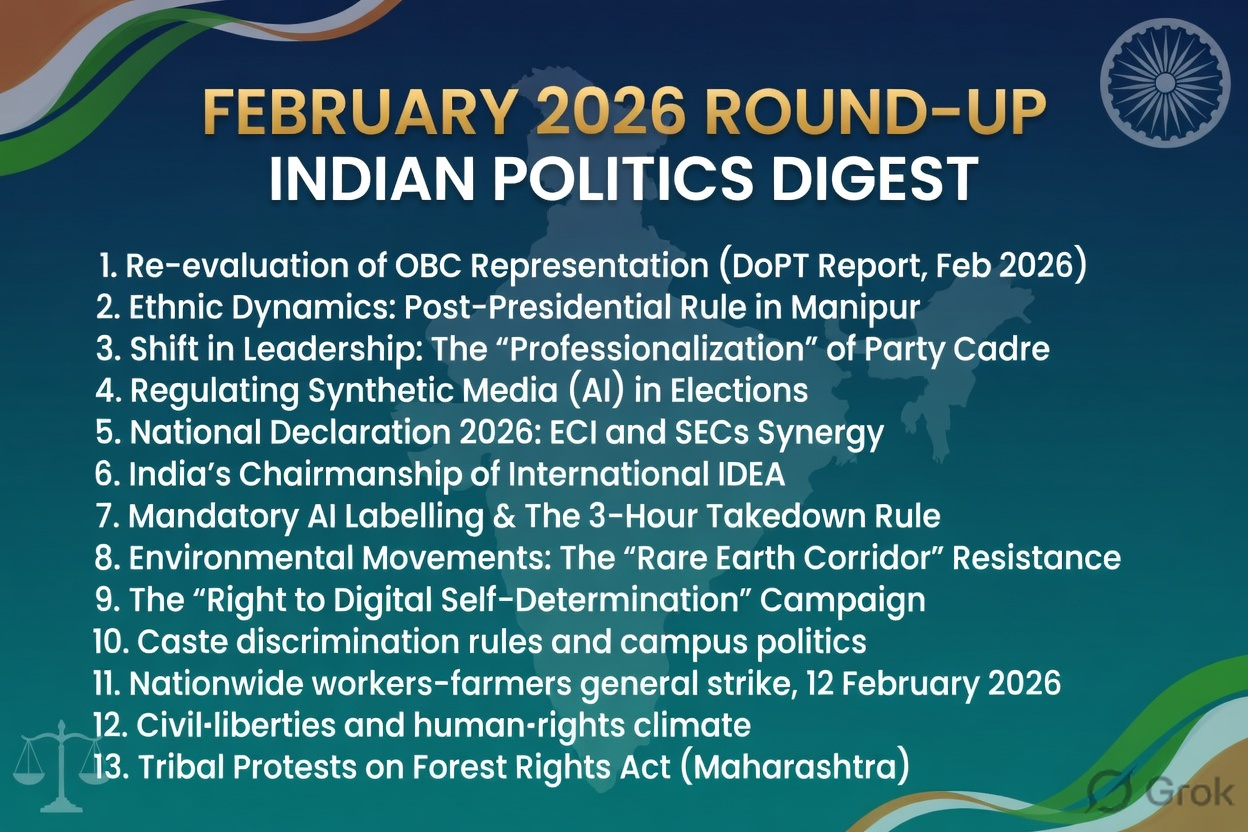
INDIAN POLITICS
|
1 |
Re-evaluation of OBC Representation (DoPT Report, Feb 2026)
Context: A Department of Personnel and Training (DoPT) report released in February 2026 highlighted that while OBC representation in entry-level (Group C) Central Government jobs has reached 27.29%, it remains stagnant at 19.14% in Group A (leadership) positions.
PSIR Significance: This underscores the gap between formal and substantive equality. For PSIR, it illustrates the concept of "glass ceilings" within bureaucratic structures despite affirmative action, and the persistent "social concentration" of certain castes in specific sectors (e.g., 66% of sanitation workers still belonging to SC/ST/OBC groups).
|
|
2 |
Ethnic Dynamics: Post-Presidential Rule in Manipur
Context: Following the revocation of Article 356 on Feb 4, 2026, the political discourse shifted toward the ethnic reconciliation between the Meitei and Kuki-Zo communities.
After nearly a year of President’s Rule, a new coalition government was sworn in with Meitei CM Y. Khemchand Singh, Kuki-Zo Deputy CM Nemcha Kipgen, and Naga Deputy CM Losii Dikho.
PSIR Significance: This is a live study of Ethnicity in Indian Politics. It showcases how ethnic identity can bypass traditional party lines, creating "Ethnic Interest Groups" that challenge the unitary nature of the state and necessitate a "Consociational" power-sharing approach.
|
|
3 |
Shift in Leadership: The "Professionalization" of Party Cadre
Context: Major national parties in February 2026 began a "structural overhaul," increasingly appointing "technocrat-presidents" (e.g., Nitin Nabin for the BJP) and prioritizing data-driven campaigning over traditional grassroots mobilization.
PSIR Significance: This reflects a change in the social base of parties. It marks a transition from "Mass Parties" to "Catch-all Parties" (Otto Kirchheimer’s theory), where ideology is often moderated to appeal to a wider, digitally-active middle class.
|
|
4 |
Regulating Synthetic Media (AI) in Elections
Context: In February 2026, the government and ECI tightened rules on AI-generated content and deepfakes to prevent the vilification of communities.
PSIR Significance: New-age challenge to Free Speech (Article 19) and "Free and Fair Elections." It highlights the state's power to regulate "synthetic media" to maintain communal harmony and "Fraternity" (as emphasized by Justice Ujjal Bhuyan in a concurrent February opinion).
|
|
5 |
National Declaration 2026: ECI and SECs Synergy
Context: For the first time in 27 years, the Election Commission of India (ECI) hosted a National Round Table Conference with State Election Commissioners (SECs) on February 24, 2026.
The Declaration: Adoption of the "National Declaration 2026", which resolves to synergize the laws governing Panchayats/Municipalities with those of Parliament/State Legislatures.
PSIR Significance: A milestone in Administrative Federalism. It addresses the "twilight zone" of election management where the ECI (Central) and SECs (State) often operate in silos despite sharing the same constitutional goal of "pure electoral rolls."
|
|
6 |
India’s Chairmanship of International IDEA
India (through the Chief Election Commissioner/ECI) has assumed the 2026 Chairmanship of the Council of Member States of International IDEA, an intergovernmental body of 35 member states that supports democracy worldwide.
India’s chairmanship theme is “Democracy for an Inclusive, Peaceful, Resilient & Sustainable World,” linking elections to SDGs, peace and inclusive governance. In this context, ECI is hosting a series of global activities (reports, trainings, conferences) throughout 2026, positioning India as a norm‑setter in election management.
The Delhi Declaration 2026 was adopted at the India International Conference on Democracy and Election Management (IICDEM) 2026 held in New Delhi, hosted by ECI and IIIDEM
42 Election Management Bodies (EMBs) from over 70 countries endorsed the Declaration, making it a collective global commitment, not just an Indian statement. It rests on five pillars: Purity of Electoral Rolls, Conduct of Elections, Research & Publications, Use of Technology, and Training & Capacity Building.
PSIR Significance: Links Indian Polity with International Relations—specifically "Democracy Diplomacy." It showcases India's role as a "Vishwa Bandhu" in setting global standards for election management.
|
|
7 |
Mandatory AI Labelling & The 3-Hour Takedown Rule
Directive: In Feb 2026, the ECI mandated that any AI-generated campaign material must carry a 10% visible watermark (e.g., "AI-Generated") and must be removed within 3 hours if found to be misleading or impersonating.
PSIR Significance: This represents the ECI's use of Article 324 (Plenary Powers) to regulate the "Technological Frontier" of elections. It addresses the challenge of maintaining a "Level Playing Field" when digital resources are unevenly distributed among parties.
|
|
8 |
Environmental Movements: The "Rare Earth Corridor" Resistance
Context: The Union Budget (Feb 2026) announced "Rare Earth Corridors" in Odisha, Kerala, and AP. Local grassroots movements in these areas immediately organized protests against potential displacement.
Why local communities are resisting?
PSIR Significance: A classic example of the "Environmentalism of the Poor" (Ramachandra Guha). These movements frame environmental protection as a matter of "Survival" rather than "Lifestyle," contrasting with Western environmental movements.
|
|
9 |
The "Right to Digital Self-Determination" Campaign
The Event: In mid-February 2026, a coalition of feminist legal collectives and tech-policy NGOs (such as the Internet Freedom Foundation and Point of View) launched a nationwide campaign titled "My Body, My Pixels."
The Argument: They argued that current laws (IT Act) view deepfakes merely as "misinformation" or "obscenity." The movement demands that AI-generated non-consensual intimate imagery (NCII) be recognized as a violation of the Right to Life and Privacy (Article 21).
PSIR Link: This is a shift from procedural rights (taking down a video) to substantive rights (the right to control one's digital likeness), reflecting the "New Social Movement" focus on identity and autonomy.
|
|
10 |
Caste discrimination rules and campus politics
New caste‑bias regulations in higher‑education institutions (drafted earlier and debated into Feb 2026) expanded the definition of discrimination to explicitly include OBCs and sharpened procedures for reporting caste harassment on campuses.
Commentary in February highlighted that these rules have triggered intense political contestation in universities: Ambedkarite, OBC and left‑student groups welcomed stronger redress; some faculty and administrators warned of “regulatory overreach” and politicisation of campus disputes, keeping caste in education at the centre of identity‑based politics.
|
|
11 |
Nationwide workers–farmers general strike, 12 February 2026
On 12 February 2026, ten central trade unions, backed by the Samyukt Kisan Morcha (SKM) and agricultural‑workers’ unions, organised a nationwide general strike against what they called a “corporate takeover” of the economy and agriculture.
The platform framed the agitation as a joint workers–peasants movement against labour‑law changes, privatisation, and agrarian distress, explicitly linking class issues with agrarian and rural identities, and drawing support from a range of opposition parties and left groups.
Protests in Jind and other Haryana districts included rallies, burning copies of the India–US trade agreement, and road‑side dharnas, with organisers claiming “100% success” in parts of the state.
In Punjab, there were rasta‑roko, pen‑down strikes by employees, and electricity‑department protests, with farmers’ unions coordinating with power‑com engineers, bank employees, and other sectoral unions.
This fits squarely under “Social movements: workers’ and farmers’ mobilisation, economic justice, and resistance to neoliberal reforms”.
|
|
12 |
Civil‑liberties and human‑rights climate (continuing context)
Human Rights Watch and other groups, whose annual reports were widely discussed through January–February, documented ongoing detention of activists, students and journalists under counter‑terrorism and public‑order laws, feeding February debates on ** shrinking civil‑liberties space** and politicisation of investigative agencies.
These discussions were picked up by opposition parties and civil‑society networks to argue that dissent and minority voices are being systematically targeted, giving PSIR material under “civil liberties and human‑rights movements in current Indian politics”
|
|
13 |
Tribal Protests on Forest Rights Act (Maharashtra):
large-scale tribal protests over Forest Rights Act (FRA) implementation gaps erupted in Maharashtra in early February 2026. Thousands of tribal farmers marched 55 km to Palghar (Jan 18-22, suspended after govt promises), with ongoing rallies highlighting delays in IFR/CFR titles, irrigation shortages, and job demands.
Protest Details Over 30,000 Adivasis protested high rejection rates (45%+ claims rejected), digital verification hurdles in remote areas, and bureaucratic resistance sidelining Gram Sabhas. Demands included time-bound title processing (11,464 pending by Apr 30), small dams/river-linking for irrigation, MSP access, and youth jobs.
Key Issues
|