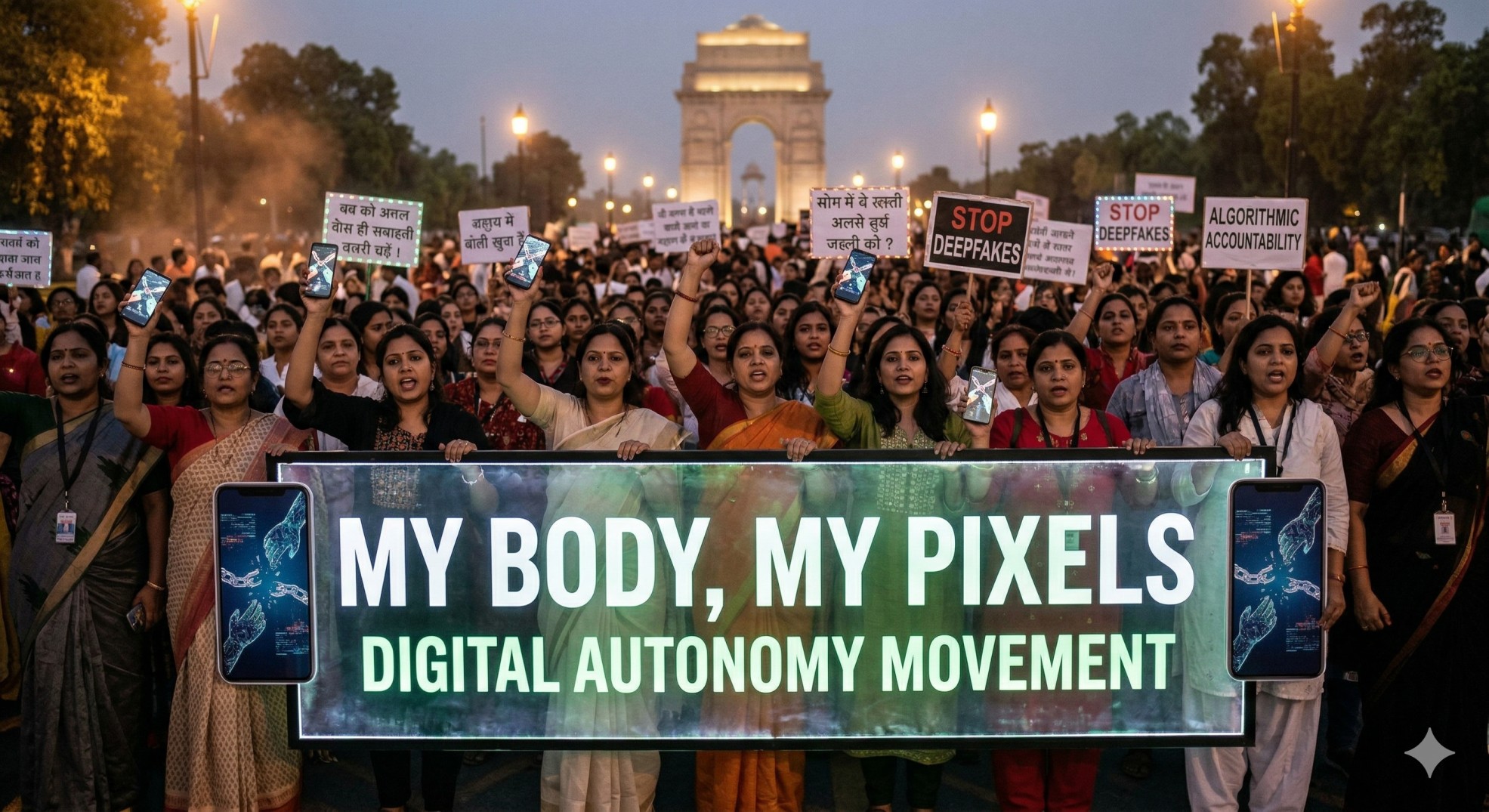
The Digital Autonomy Movement (Feb 2026)
The rapid evolution of generative artificial intelligence has moved the battleground for gender equality from physical spaces to the digital frontier. In February 2026, India witnessed the emergence of the Digital Autonomy Movement, a pivotal shift in the country's socio-political landscape. This movement, spearheaded by a coalition of feminist legal collectives and tech-policy NGOs, marks a transition from traditional advocacy to a sophisticated demand for substantive digital rights.
Unlike previous movements focused primarily on procedural legal parity, this new wave of activism—headlined by the "My Body, My Pixels" campaign—redefines AI-generated non-consensual imagery not just as misinformation, but as a fundamental violation of the Right to Life and Privacy under Article 21. From high-profile protests at the India AI Impact Summit to the institutional evolution of the National Commission for Women’s "Digital Shakti 6.0," the movement is successfully pushing for algorithmic accountability and "Safety-by-Design" principles. By positioning women not merely as victims of technology but as its architects, the movement is actively reshaping India’s Digital Public Infrastructure (DPI) and setting a global precedent for tech governance in the Global South.
1. The "Right to Digital Self-Determination" Campaign
- The Event: In mid-February 2026, a coalition of feminist legal collectives and tech-policy NGOs (such as the Internet Freedom Foundation and Point of View) launched a nationwide campaign titled "My Body, My Pixels."
- The Argument: They argued that current laws (IT Act) view deepfakes merely as "misinformation" or "obscenity." The movement demands that AI-generated non-consensual intimate imagery (NCII) be recognized as a violation of the Right to Life and Privacy (Article 21).
- PSIR Link: This is a shift from procedural rights (taking down a video) to substantive rights (the right to control one's digital likeness), reflecting the "New Social Movement" focus on identity and autonomy.
2. Protest at the "India AI Impact Summit" (Feb 16–20, 2026)
- The Event: During the Global AI Summit at Bharat Mandapam, New Delhi, women activists and student groups (including members of the Indian Youth Congress and independent feminist tech-collectives) staged a protest against the "Safety-by-Design" gaps in popular Generative AI tools.
- Specific Demand: They targeted tools like Grok-AI and other open-source "undressing" apps, demanding that AI developers be held criminally liable as "abettors" if their software lacks "Feminist Design Principles" (e.g., proactive blocking of photorealistic non-consensual nudes).
- PSIR Link: Illustrates Pressure Group politics where civil society influences global tech-governance standards.
3. Institutional Response: The NCW’s "Digital Shakti 6.0"
- The Directive: On February 11, 2026, the National Commission for Women (NCW), in collaboration with MeitY, released a new "Victim-Centric Protocol" under the Mission Shakti framework.
- Key Feature: It introduced a "2-Hour Emergency Takedown" window specifically for NCII—shorter than the standard 3-hour window for other illegal content. This was a direct result of intense lobbying by women’s rights groups throughout early February.
- PSIR Link: Demonstrates the responsiveness of Quasi-Judicial/Constitutional bodies to social movements and the "Changing Socio-Economic Profile" of leadership that prioritizes digital safety.
4. The "Casebook on AI and Gender Empowerment"
- The Launch: On February 17, 2026, the Government of India and UN Women released a casebook highlighting 23 AI solutions designed by women to combat technology-facilitated gender-based violence (TFGBV).
- Significance: It shifted the narrative from women as "victims of AI" to women as "architects of AI." Activists used this launch to demand more women in the "Seven Chakras" (working groups) of the IndiaAI Mission.
- PSIR Link: Relevant to Women’s Movements and their role in shaping the "Digital Public Infrastructure" (DPI) of the Global South.
|
Feature
|
Traditional Women's Movement
|
Digital Autonomy Movement (Feb 2026)
|
|
Core Issue
|
Physical violence, Property rights
|
AI-Deepfakes, NCII, Data Privacy
|
|
Key Demand
|
Legal parity, Reservation
|
Algorithmic Accountability, "Right to be Forgotten"
|
|
Primary Target
|
The State (Police/Courts)
|
Big Tech Intermediaries & AI Developers
|
|
Constitutional Basis
|
Article 14, 15
|
Article 21 (Right to Dignity in Digital Space)
|
Discuss the concept of 'Safety-by-Design' in Generative AI. To what extent should AI developers be held criminally liable as 'abettors' for the misuse of their software?
The concept of "Safety-by-Design" and the accompanying debate over developer liability have become central to India’s digital discourse in early 2026, particularly following the rise of the Digital Autonomy Movement.
1. The Concept of "Safety-by-Design"
"Safety-by-Design" is a proactive regulatory and technical framework that requires AI developers to integrate safety features into the core architecture of their tools, rather than treating misuse as an after-the-fact moderation issue.
- Feminist Design Principles: Activists argue that tools like Grok-AI or open-source "undressing" apps must include "Feminist Design Principles," which involve the proactive blocking of photorealistic non-consensual nudes and the mitigation of inherent gender biases.
- Algorithmic Accountability: This principle shifts the focus from procedural rights (the ability to request a takedown) to substantive rights, where the software is designed to prevent the creation of harmful content like Non-Consensual Intimate Imagery (NCII) in the first place.
- Technical Mandates: Under the updated IT Rules 2026, intermediaries providing synthetic content tools are now mandated to deploy "appropriate technical measures," such as permanent, tamper-resistant metadata and automated systems to prevent the dissemination of child sexual exploitation or malicious deepfakes.
2. Criminal Liability as "Abettors"
The demand to hold developers criminally liable as "abettors" is a significant escalation in the legal strategy of digital rights groups.
Arguments for Criminal Liability
- Inadequate Safeguards: Movement leaders argue that if a developer releases software specifically designed for—or easily adapted to—the creation of NCII (Non-Consensual Intimate Imagery) without robust safeguards, they are effectively "abetting" the crime.
- Shift in Constitutional Basis: By framing digital likeness as part of the Right to Life and Privacy (Article 21), activists seek to move beyond civil penalties toward criminal accountability for those who provide the means for such violations.
- Pressure on Global Tech: This approach acts as a pressure group tactic to force global AI developers to comply with local safety standards or face criminal prosecution in India, potentially treating them similarly to how corporate criminal liability is handled under the Bharatiya Nyaya Sanhita.
Challenges and Counter-Arguments
- Safe Harbor Protections: Traditionally, Section 79 of the IT Act has provided "safe harbor" to intermediaries, protecting them from liability for user-generated content as long as they follow due diligence.
- Liability vs. Accountability: There is a legal distinction between accountability (being answerable for outcomes) and liability (bearing legal consequences like penalties or jail time). Critics argue that strict criminal liability for developers may stifle innovation and that existing negligence or tort laws are more appropriate for software defects.
- Dual-Use Dilemma: Developers often argue that software is a tool that can be used for both legitimate and illegitimate purposes, and they should not be held responsible for the malicious intent of an individual user.
As of February 2026, the institutional response has leaned toward tightening procedural protocols—such as the NCW’s "2-Hour Emergency Takedown" window—while the debate over making "Safety-by-Design" a criminal requirement for developers continues to be a major point of contention in Indian politics and law.
Practice Questions for PSIR
- "Analyze the 'Digital Autonomy Movement' as a 'New Social Movement.' How does its focus on identity and digital likeness differ from traditional women’s movements centered on legal parity and reservations?"
- "Examine the role of tech-policy NGOs and feminist collectives as pressure groups in influencing global tech-governance standards during international summits like the India AI Impact Summit."
- "Assess the significance of the 'Casebook on AI and Gender Empowerment' in shifting the narrative of women from passive subjects to architects of the Digital Public Infrastructure in the Global South."
- "The demand for the 'Right to Digital Self-Determination' represents an expansion of Article 21. Comment on the judicial and social evolution of the Right to Dignity in the digital age."
-
The transition from a 3-hour to a 2-hour 'Victim-Centric Protocol' for NCII reflects a growing responsiveness in India's quasi-judicial bodies. Evaluate the role of the National Commission for Women (NCW) in addressing Technology-Facilitated Gender-Based Violence (TFGBV).
-
Discuss the concept of 'Safety-by-Design' in Generative AI. To what extent should AI developers be held criminally liable as 'abettors' for the misuse of their software?
-
How do deepfakes and AI-generated non-consensual intimate imagery (NCII) pose a challenge to the existing framework of the IT Act? Suggest measures for strengthening digital dignity.