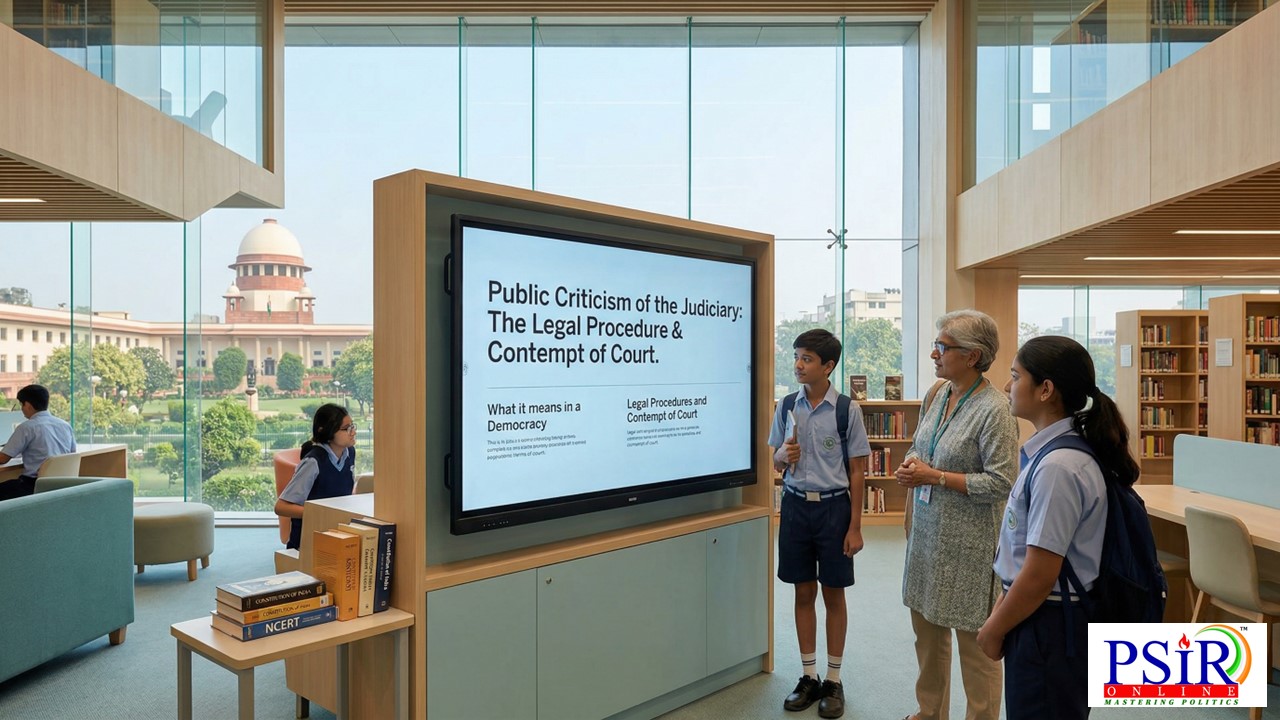
In February 2026, a three-judge Supreme Court bench led by Chief Justice of India Surya Kant took suo motu cognizance of a Class 8 NCERT Social Science textbook chapter titled “The Role of the Judiciary in Our Society.” The chapter discussed real challenges facing the Indian judiciary, including corruption at various levels and the massive backlog of cases. The Court ordered the immediate withdrawal of the entire book Exploring Society: India and Beyond (Vol II), seizure of physical copies, removal of digital versions, and barred any republication—even under alternate titles or through electronic media. Describing the content as part of a “deep-rooted, well-orchestrated conspiracy” to malign the judiciary, the bench remarked that the “judiciary is bleeding today” and that “heads must roll.” NCERT promptly apologised, calling it an “error of judgment,” and withdrew the book.
This episode has ignited a sharp debate on the delicate balance between judicial independence and the public’s right to criticise institutions in a democracy. It raises fundamental questions:
Where does legitimate criticism end and contempt begin?
Does open discussion about judicial shortcomings strengthen or weaken public faith in the courts?
And what role should education play in fostering constitutional awareness?
WHAT PUBLIC CRITICISM OF THE JUDICIARY MEANS?
Public criticism of the judiciary refers to the right of citizens, media, academics, and civil‑society actors to comment on judicial functioning, delays, perceived bias, or institutional vulnerabilities such as corruption or backlog. In a constitutional democracy, such criticism is not an attack on the institution per se, but part‑of the broader “checks and balances” that keep power, including adjudicative power, accountable to the people. Free and reasoned critique also helps build constitutional literacy, especially when, as in the NCERT chapter, exercises are framed around the judiciary’s role, challenges, and accountability mechanisms rather than nakedly polemical attacks
THE LEGAL FRAMEWORK: CONTEMPT OF COURT IN INDIA
The power of courts to punish criticism stems from the Contempt of Courts Act, 1971, which defines two types of contempt: civil (wilful disobedience of court orders) and criminal. Criminal contempt under Section 2(c) includes any act that “scandalises or tends to scandalise, or lowers or tends to lower the authority of any court.” This broad definition covers publications or statements that could erode public confidence in the judiciary.
However, the Act itself carves out protections. Section 5 explicitly states that fair criticism or fair comment on the merits of a finally decided case does not amount to contempt. The Supreme Court has repeatedly clarified that criticism of judgments, even if strong or trenchant, is permissible if it is bona fide and in the public interest. In the 1988 case of P.N. Duda v. P. Shiv Shankar, the Court held that fair comment on matters of public interest, including the functioning of the judiciary, enjoys protection under Article 19(1)(a) of the Constitution (freedom of speech and expression).
The Constitution itself grants the Supreme Court (Article 129) and High Courts (Article 215) the status of courts of record with inherent power to punish for contempt. Yet this power is not absolute; it must be exercised with restraint, as the judiciary itself has acknowledged in several judgments.
Unlike ordinary criminal cases, contempt proceedings can be initiated by the Supreme Court or High Court on their own motion (suo motu)—without any formal complaint. For criminal contempt not committed in the court’s presence, the Act generally requires the consent of the Attorney General (for the Supreme Court) or the Advocate General (for High Courts) when a private person files a petition. The accused is served a notice, given an opportunity to defend themselves, and the matter is heard by a bench of at least two judges. Punishment can extend to six months’ imprisonment, a fine, or both.
In the NCERT case, the Supreme Court acted suo motu after media reports highlighted the chapter, treating the textbook’s discussion of systemic issues as an attempt to “scandalise” the institution rather than fair academic discourse. Critics argue this reflects a growing tendency to equate institutional criticism with personal attack on judges.
WHY PUBLIC CRITICISM IS ESSENTIAL IN A DEMOCRACY?
Judges in India are not elected; they wield enormous power as unelected guardians of the Constitution. In a democracy, no institution—least of all one exercising judicial review over the executive and legislature—can remain immune from public scrutiny. Public criticism serves multiple vital purposes:
THE RISKS OF UNRESTRAINED OR BASELESS CRITICISM
While healthy criticism strengthens democracy, there is a compelling case that baseless, malicious, or sweeping allegations—especially when they become normalised—can seriously damage the judiciary and the broader polity.
First, the judiciary is widely regarded as the guardian of the Constitution and the rights of citizens. In India’s constitutional scheme, it is the final arbiter protecting fundamental rights against executive or legislative overreach. When people lose faith in this guardian due to repeated, unsubstantiated claims of corruption or bias, it creates a dangerous vacuum. Citizens may turn to extra-constitutional or “non-political” routes—vigilantism, mob justice, or parallel dispute-resolution mechanisms—undermining the rule of law. Former Supreme Court judge Justice B.R. Gavai has warned that declining public trust can push people toward corruption, mob violence, and other destabilising alternatives, weakening the social contract that sustains Indian democracy.
Second, if baseless allegations of corruption or institutional capture become a cultural norm, they risk fracturing the delicate balance of Indian polity. The judiciary’s legitimacy rests on public confidence. Once eroded, it becomes harder for courts to enforce unpopular but correct decisions, leading to greater executive-legislative-judicial friction and potential constitutional crises.
Third, criticism of ongoing cases (sub-judice matters) poses a direct threat to fair trial rights. Public opinion shaped by media campaigns, social media outrage, or textbook-style generalisations can create an atmosphere of pressure on judges. As Justice J.B. Pardiwala of the Supreme Court observed, personal attacks and media scrutiny force judges to worry about “what the media thinks instead of what the law really thinks,” harming the rule of law. Senior judges have repeatedly described “trial by media” as the antithesis of justice, noting that it can prejudice outcomes and turn judges into populists who deliver verdicts based on public sentiment rather than evidence and law. In a country with high social media penetration and uneven legal literacy, such influence can distort justice and make courts appear to bend to popular aspirations instead of upholding the Constitution.
Fourth, the judiciary, unlike the executive or legislature, cannot easily defend itself in the public square. Judges speak only through their judgments. Unchecked scandalising therefore tilts the balance unfairly. The Supreme Court has itself noted in multiple rulings that “criticism, if not checked, would destroy the institution itself.” In a young democracy with a vast population still developing civic norms around institutional respect, the Allahabad High Court once observed that unbridled liberty to scandalise courts could be “very dangerous.”
DOES SUCH CRITICISM UNDERMINE THE JUDICIARY?
This is the core tension. The Supreme Court in the NCERT matter viewed the chapter as part of a “calculated move” that would “tarnish the image of the judiciary in the eyes of the general public.” Senior advocate Harish Salve has argued that while court decisions can be criticised—even in impolite language—allegations of corruption or loss of independence, if baseless, undermine public faith and may cross into contempt. He noted that ill-informed criticism should ideally be countered by the Bar, not always through contempt powers.
Yet prominent voices have cautioned against over-sensitivity. Former Supreme Court judge Justice H.R. Khanna, the legendary dissenter during the Emergency, famously stated: “Contempt of court should not be used as a means to uphold our own dignity. This must rely on surer foundation… We must rely on our conduct itself to be its own vindication.”
Criticism becomes problematic only when it is factually baseless, malicious, or deliberately designed to incite public hostility against the institution. But when criticism is grounded in documented challenges—such as massive pendency (roughly 81,000 cases pending in the Supreme Court, 6.24 million in High Courts, and about 47 million in subordinate courts, as cited in the NCERT text) or systemic vacancies and procedural complexity—it performs a diagnostic, not a destructive, function. The late Justice V. R. Krishna Iyer, a towering figure in Indian judicial history, often emphasised that democracy cannot afford “judicial complacency” and that the judiciary must “welcome constructive criticism and introspection.” Seen through such a lens, educating school‑going citizens about the judiciary’s strengths and its genuine challenges is closer to democratic maturity than to institutional sabotage.
EDUCATION, CONSTITUTIONAL CULTURE, AND THE WAY FORWARD
The NCERT episode highlights a deeper question: What kind of constitutional culture do we want to nurture? Teaching young students only about the judiciary’s glory while omitting its challenges does a disservice to future citizens. An informed public that understands both the judiciary’s pivotal role and its imperfections is better equipped to defend judicial independence when it is genuinely threatened.
The judiciary’s power ultimately rests not on fear of contempt but on public confidence earned through impartiality, efficiency, and accountability. As Justice Khanna reminded us, the surer foundation is the judiciary’s own conduct. In a vibrant democracy, public criticism—when fair, evidence-based, and in good faith—should be welcomed as a sign of maturity, not treated as a conspiracy.
The real test of institutional strength lies not in silencing uncomfortable questions, but in addressing them.
PUBLIC CRITISM OF JUDICIARY IN OTHER COUNTRIES
The United Kingdom: Strict on Sub Judice, Liberal on Institutional Criticism
In the UK, contempt of court law primarily focuses on protecting ongoing proceedings rather than shielding the judiciary’s reputation from general criticism.
Today, UK judges tolerate strong, even unfair, criticism of judgments or systemic issues (delays, perceived biases) as long as it does not interfere with specific active cases or amount to direct obstruction. The emphasis is on the judiciary’s conduct earning respect, not enforced deference through contempt. Parliamentary debates have a separate sub judice resolution, but the Speaker can waive it for broader public interest discussions.
The United States: Broad First Amendment Protections
The US offers even stronger safeguards for public criticism of the judiciary, rooted in the First Amendment’s guarantee of free speech and press.
In short, the US treats the judiciary like any other public institution: open to robust, sometimes vitriolic, criticism. Legitimacy flows from transparency and performance, not from legal protection against uncomfortable speech.
Key Differences from India and Implications
Compared to India’s Contempt of Courts Act, 1971—which still includes a wide “scandalising” provision that courts have used suo motu against media, activists, and even academic-style discussions—the UK and US approaches are markedly more speech-protective.

These Western models reflect the view that excessive use of contempt to punish criticism can itself erode public trust by creating an impression of judicial hypersensitivity or opacity. As Lord Atkin observed, “Justice is not a cloistered virtue; it must suffer the scrutiny and outspoken comments of ordinary men.”
GS 2 MAINS PRACTISE QUESTIONS
PSIR OPTIONAL PRACTISE QUESTIONS